The Paris issue
Paris Under Glass: Walking the Passages Couverts as Balzac Did
A slow, walkable circuit through Paris's iron-and-glass arcades — grand, faded, and delicious — traced the way Balzac's characters once haunted them.

By Sasha LindholmThe unhurried side of Paris
The rain that once drove Parisians indoors is the reason the city keeps these particular secrets under glass. Long before department stores, a generation shopped, gossiped and idled beneath iron-and-glass roofs that turned a wet afternoon into a stage — and Balzac, who set some of the sharpest scenes of Lost Illusions inside exactly these corridors, read them as theatres of ambition and small ruin. Nearly two centuries on, the passages couverts are mostly still here, mostly free to enter, and mostly unbothered by the crowds three streets away — waiting for anyone willing to walk slowly.
There are around a dozen worth the detour, and the pleasure is that they cluster. You can string most of them into a single unhurried day on foot, crossing from the Louvre to the Grands Boulevards to the old garment quarter without ever needing the Métro between stops. What follows is a route rather than a ranking. Take it in order and the city rearranges itself into a sequence of lit tunnels; skip around and you'll still stumble into the next one within a few hundred metres.
Where Balzac's Paris still stands: the Palais-Royal cluster
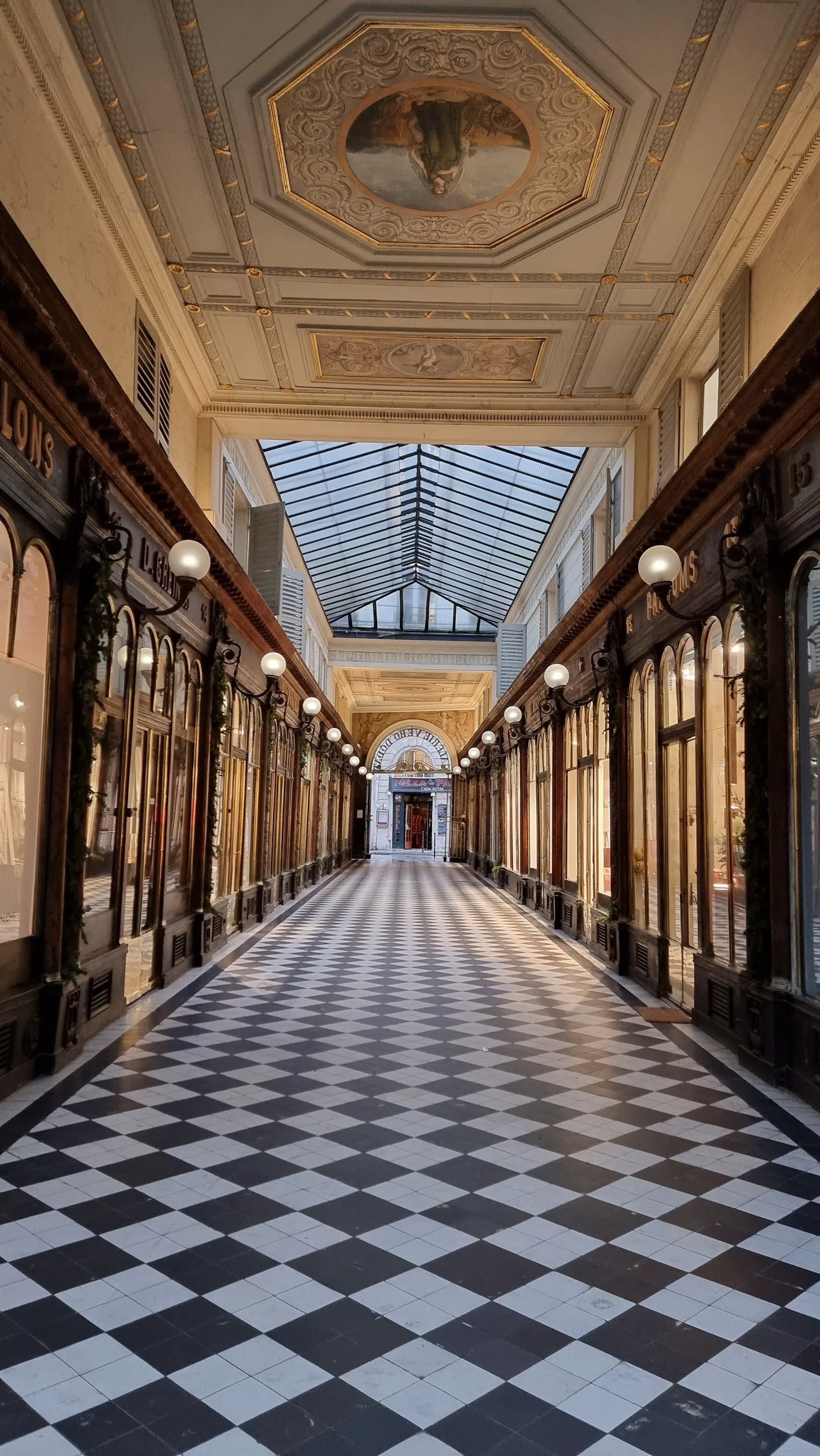
Begin beside the Louvre, because the grandest of the short arcades is here and it sets the tone. Galerie Véro-Dodat (1st, a minute from the Louvre) is the most opulent of the miniatures — a jewel-box of black-and-gold shopfronts, painted ceilings and mirrored panels laid down in the 1820s by two prosperous butchers who wanted their address to look like money. It is small and refined, which makes it perfect for a couple or a compact group and slightly awkward for a crowd; the Louboutin flagship and the men's store keep it feeling upscale rather than touristy. Everything inside is luxury-priced, so treat it as a place to look, photograph and covet rather than to shop unless your budget runs to red soles.
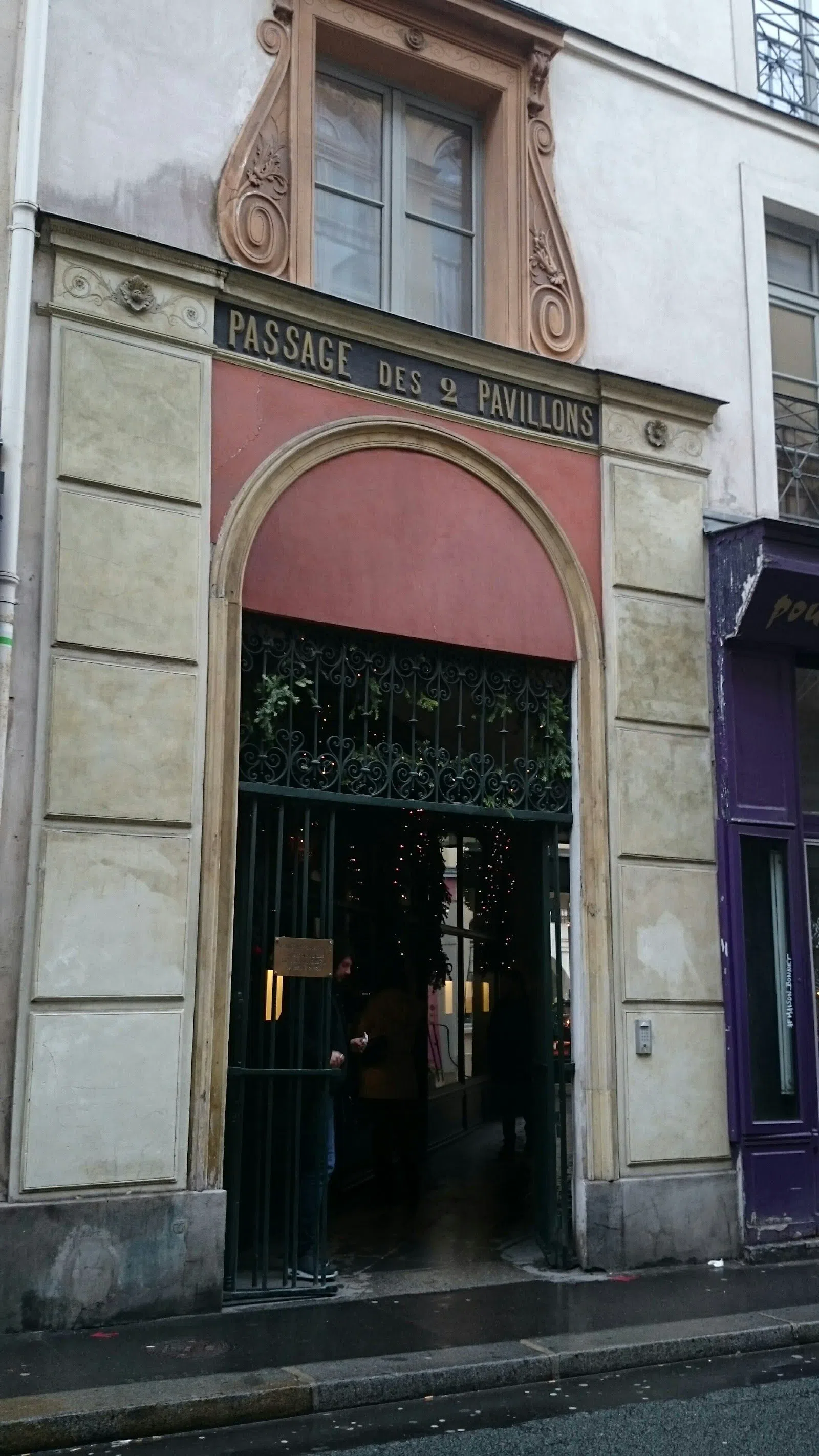
Walk north through the arcades and colonnades toward the Palais-Royal and you'll pass through Passage des Deux Pavillons (Palais-Royal, 1st), which barely counts as a destination and knows it. It is genuinely tiny — a short flight of steps and a roofed link, best simply walked through by a small group. Include it for exactly what it is: the natural connector between the Palais-Royal gardens and the finest arcade on the whole route, not a stop in its own right.
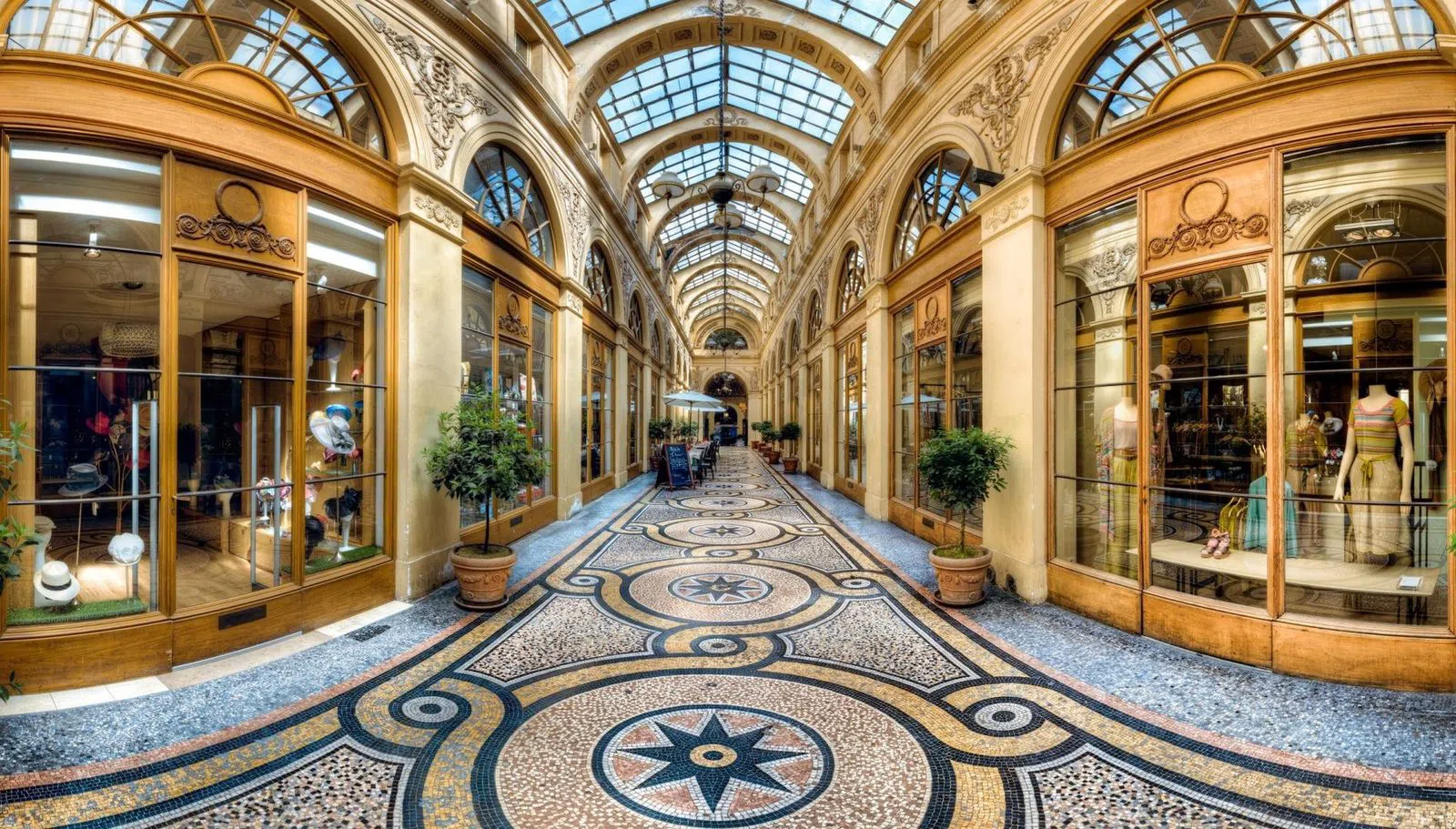
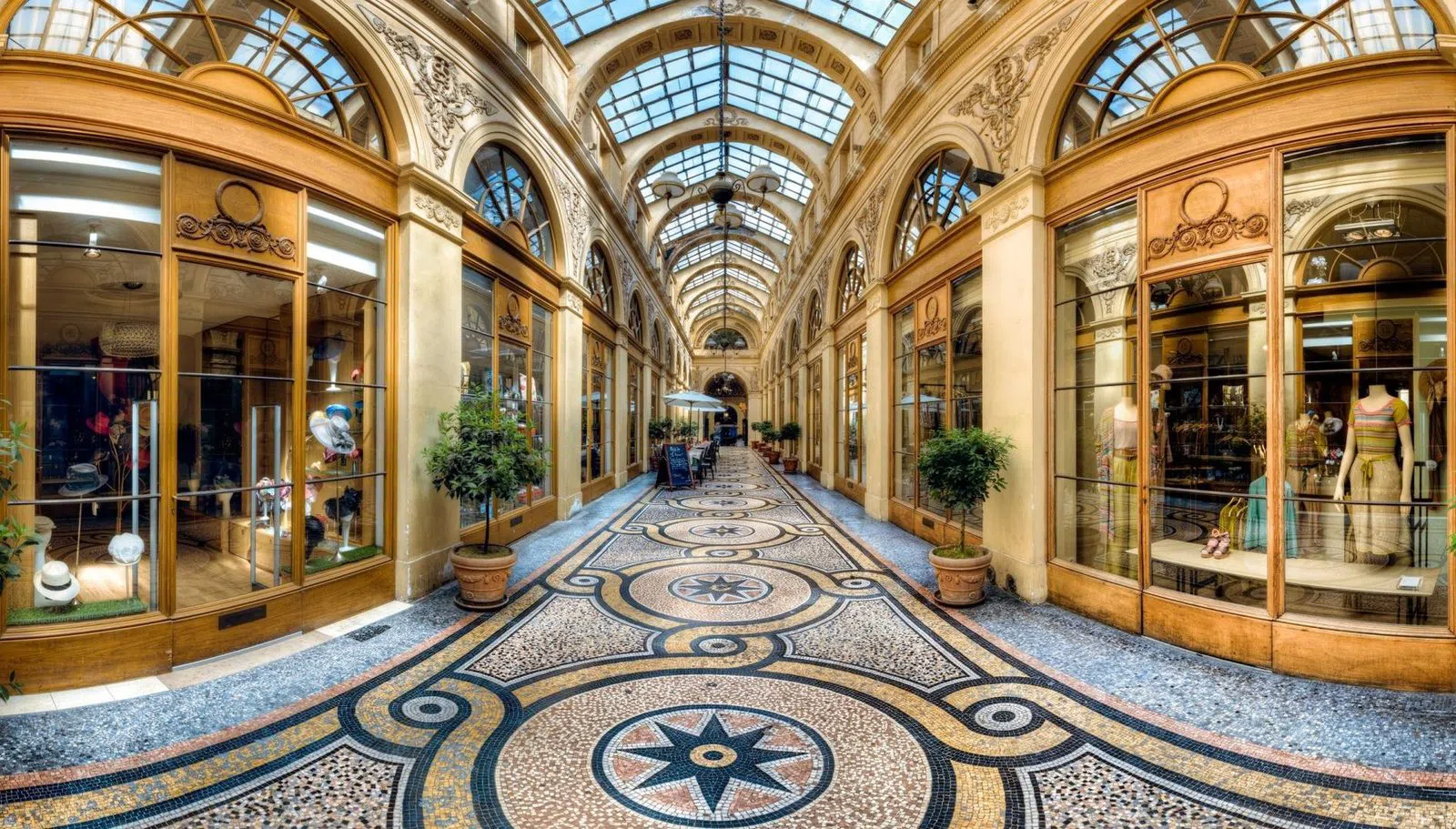
That finest arcade is Galerie Vivienne (near the Bourse, 2nd), and it earns the obvious billing. Opened in 1823, it is the single most beautiful and photogenic of them all: a rippling mosaic floor by Facchina, a graceful rotunda, arched glass and neoclassical goddesses looking down on a bookshop that has traded here for generations. It is a public thoroughfare — free, no door policy — and walking-tour groups pass through more or less constantly, so it never feels private, but it is wide enough to absorb them. Larger groups should keep to one side so the boutiques can breathe. The shops are high-end and the bistro mains run roughly €20–35, but the best thing to do here costs the price of a glass: step into Legrand Filles et Fils, the wine merchant tucked inside the gallery, for a tasting among old bottles and painted shelving. It is the obvious anchor of any arcade day, and a good place to decide whether you're the sort of traveller who wants more of this or a change of register.
Plan your Paris trip
Live prices from our booking partners.
Free cancellation on many rooms. We may earn a commission when you book.
The Grands Boulevards run: the oldest, the busiest, the calmest
From Vivienne it's a short walk north-east to the Grands Boulevards, where three passages sit almost in a row and give you the fullest range of moods in a single stretch.
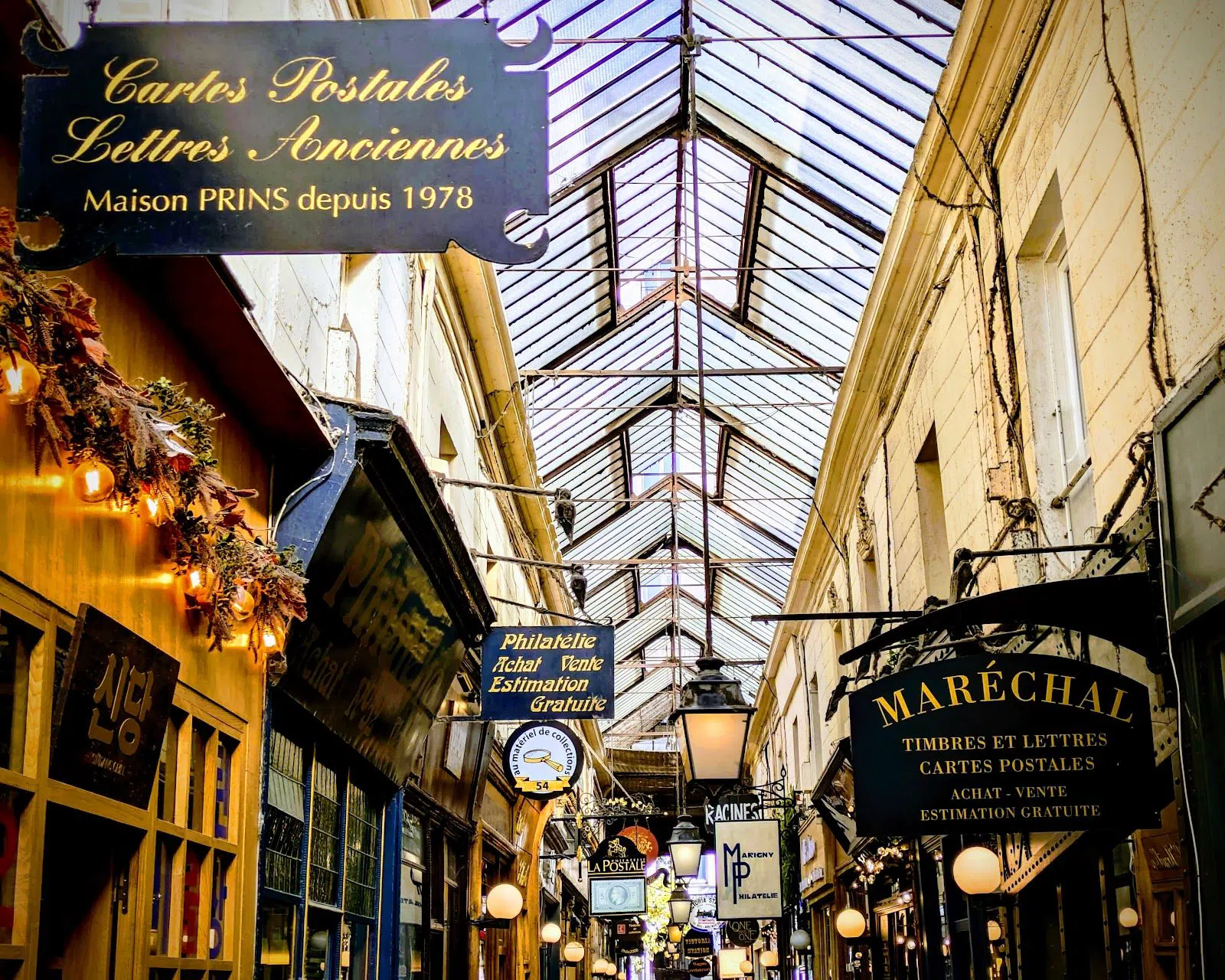
Passage des Panoramas (Grands Boulevards, 2nd) is the oldest of them all and, these days, the district's foodie hotspot. It began in 1800 as a novelty attached to a pair of painted rotundas — the "panoramas" that gave it its name — and it has never stopped buzzing, day and night. The trade-off for that energy is width: the corridor is narrow, and at peak dinner hours a group is better off going single-file and, above all, booking ahead. The little wine bars and bistros — plates and mains roughly €15–40 — are genuinely good and genuinely tiny, and they fill fast, so a party of four or more that turns up hoping for a table will usually be turned away. Come with a reservation and it is one of the most atmospheric dinners in central Paris; come on spec at eight o'clock and you'll spend your evening reading menus you can't get into. In between the restaurants, look for the old engravers, the stamp and postcard dealers, and the faded painted signs that Balzac's ambitious provincials would still recognise.
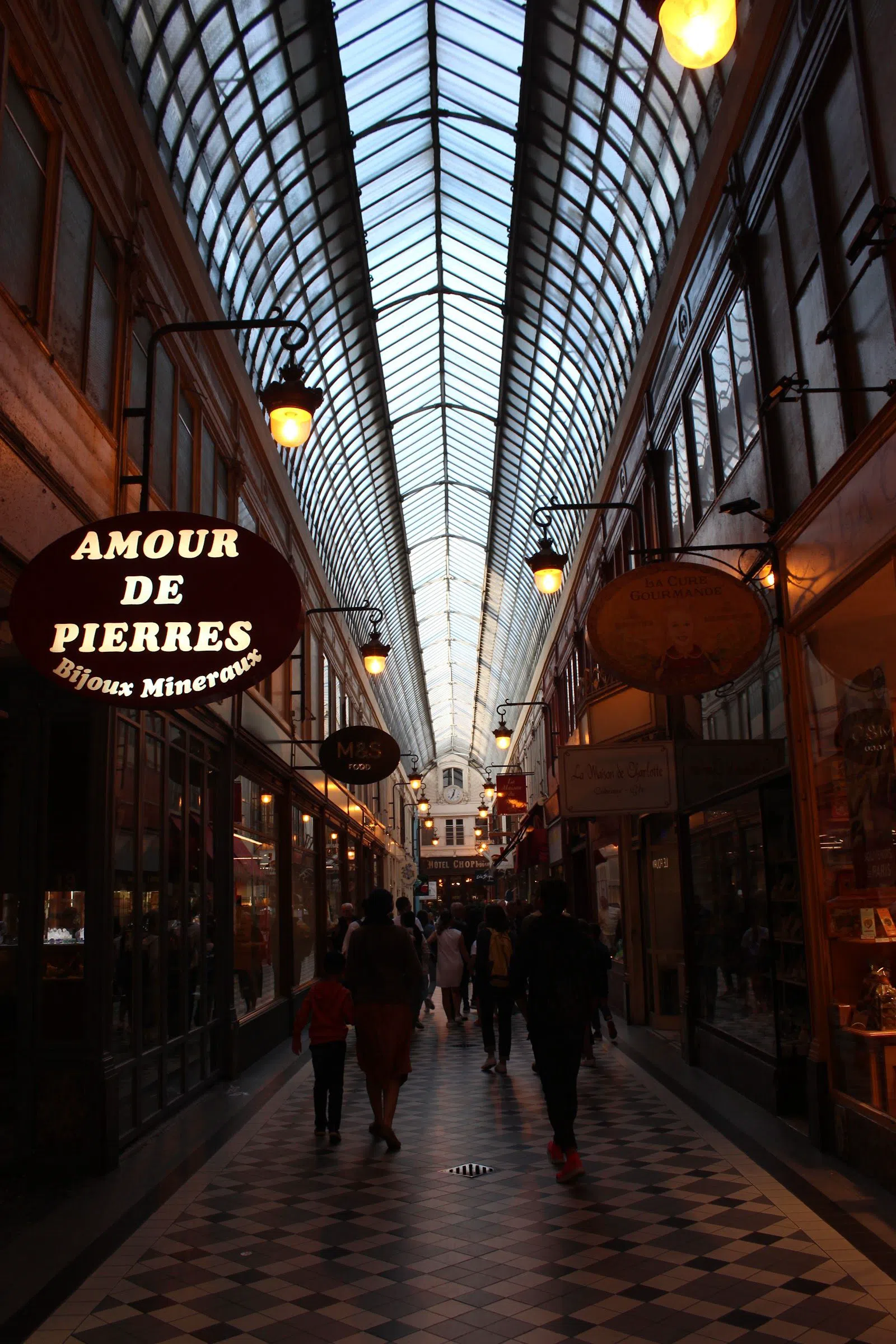
Cross the boulevard Montmartre and you step straight into Passage Jouffroy (boulevard Montmartre, 9th), the most family- and group-friendly arcade on the route. This is where the Musée Grévin, the city's grand old waxworks, spills its queue into the passage; the museum takes group bookings and charges around €26.50 for an adult ticket, which makes it the one paid attraction worth planning around if you're travelling with mixed ages. Around it are toy shops, a walking-stick specialist, second-hand bookshops and the tiny Hôtel Chopin at the far end, wearing its 1846 fittings without irony. Jouffroy is bright, sloping and easy to walk together, and it does something no other passage does: it flows directly across a side street into its quieter sibling for a seamless double-header.
That sibling is Passage Verdeau (9th), the calm counterpoint to everything you've just walked. It is the collectors' arcade — antiquarian prints and books, old cameras, curiosities priced from a few euros upward — and it is markedly quieter than its neighbours, which makes it comfortable for a browsing group that doesn't want to shuffle. If Panoramas is about eating and Jouffroy about entertaining the children, Verdeau is about lingering over a tray of engravings with no one at your shoulder. Anyone who loves paper, patina and the smell of old bindings should save time for it.
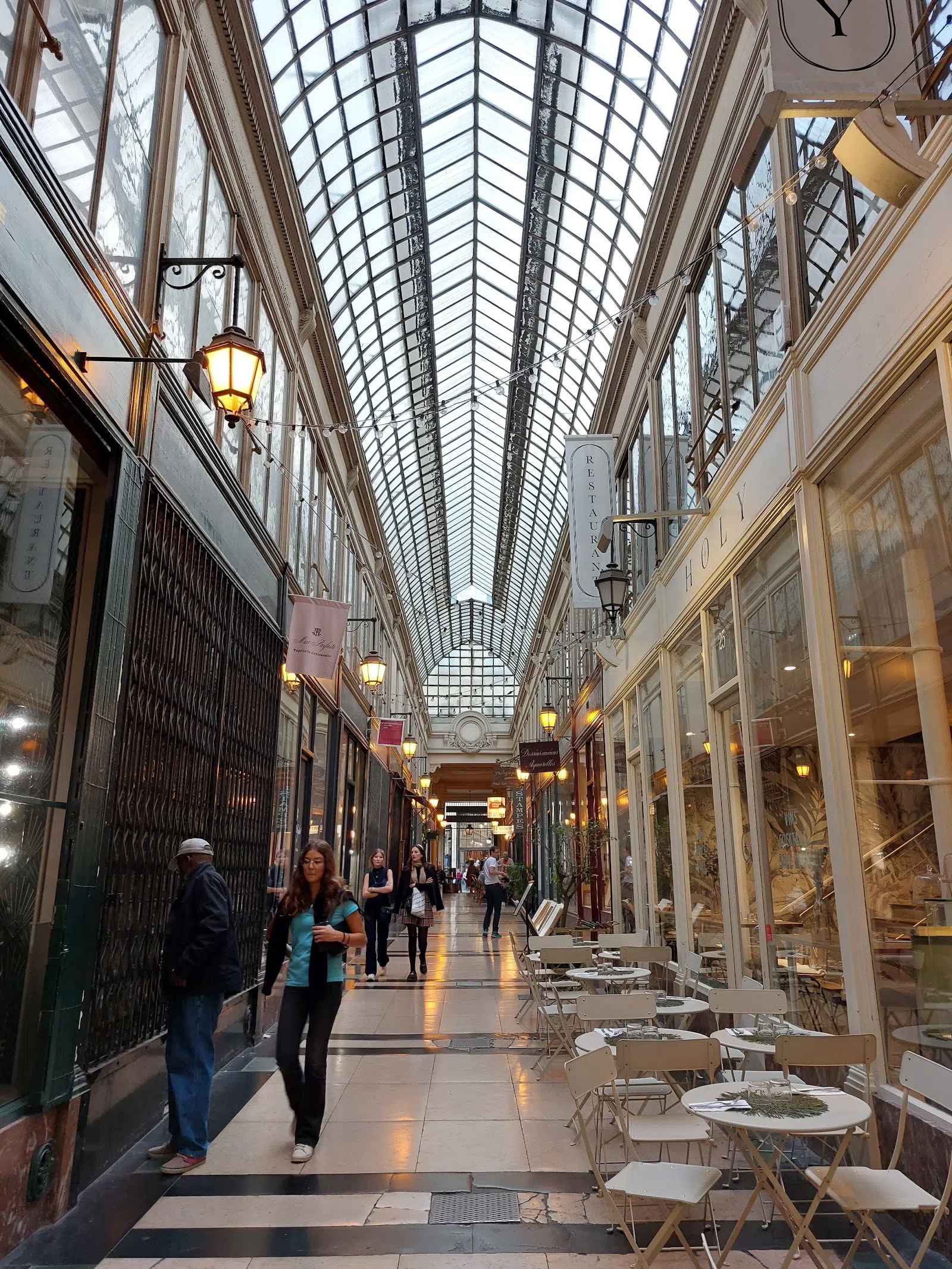
The Sentier side: light, stone and honest grit
Drop back south toward the old garment district and the character shifts again — less nostalgia, more working city.
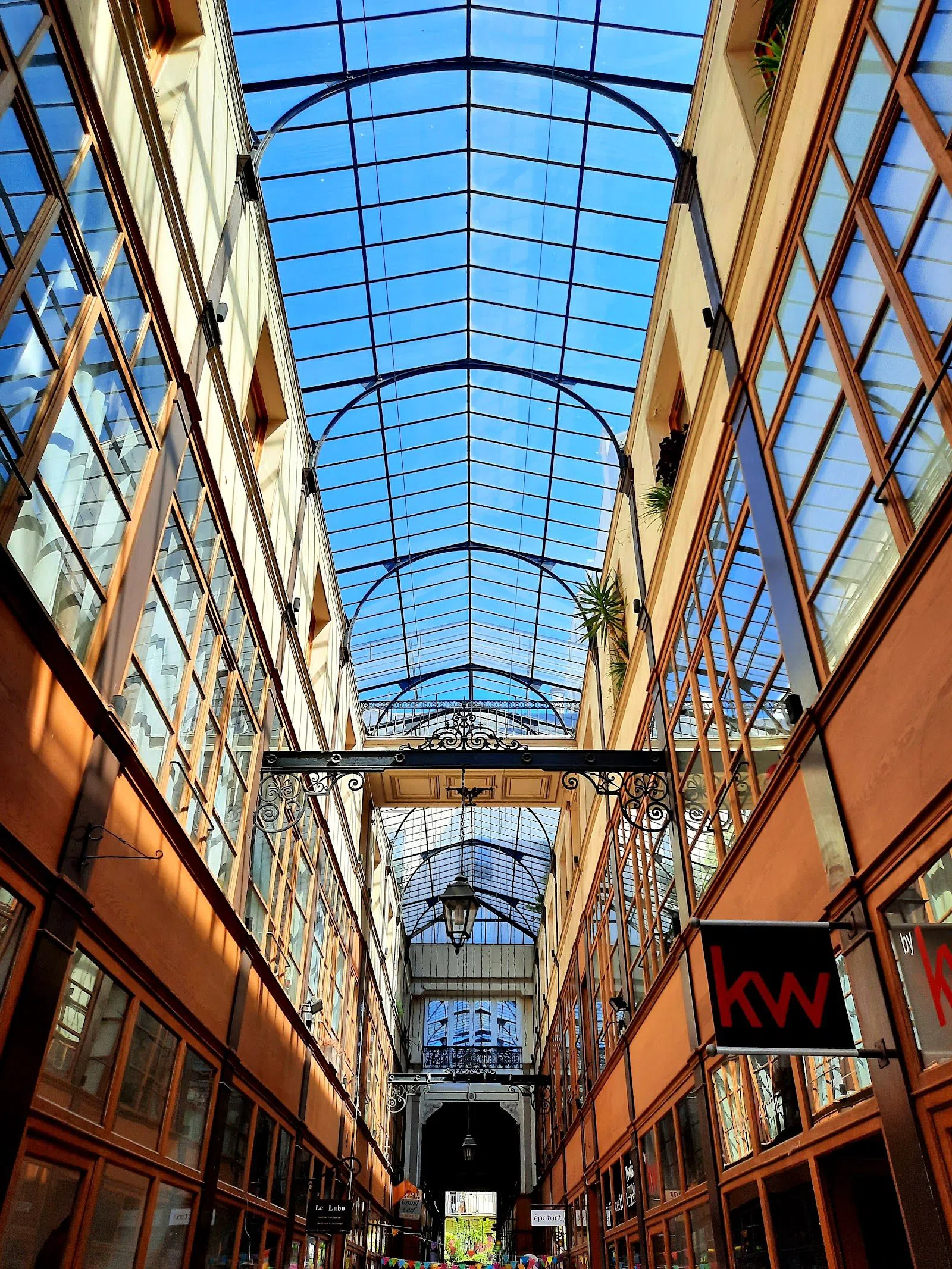
Passage du Grand Cerf (Montorgueil, 2nd) is the surprise of the route and, for many, the best of the modern ones. It is the tallest and most light-filled passage in Paris, a soaring three-storey nave of iron and glass that feels less like a tunnel than an indoor street. That height and width make it the most group-comfortable arcade for browsing, and the tenants are the reason to come: contemporary independent designers, jewellers and makers rather than dealers in the past. Le Pas Sage, the wine bar and bistro inside, takes bookings and does plates in the €15–30 range — a good, unfussy stop for a group that wants to sit down without a production. If Vivienne is the nineteenth century at its most gilded, Grand Cerf is proof the form still works when it's pointed at the present.
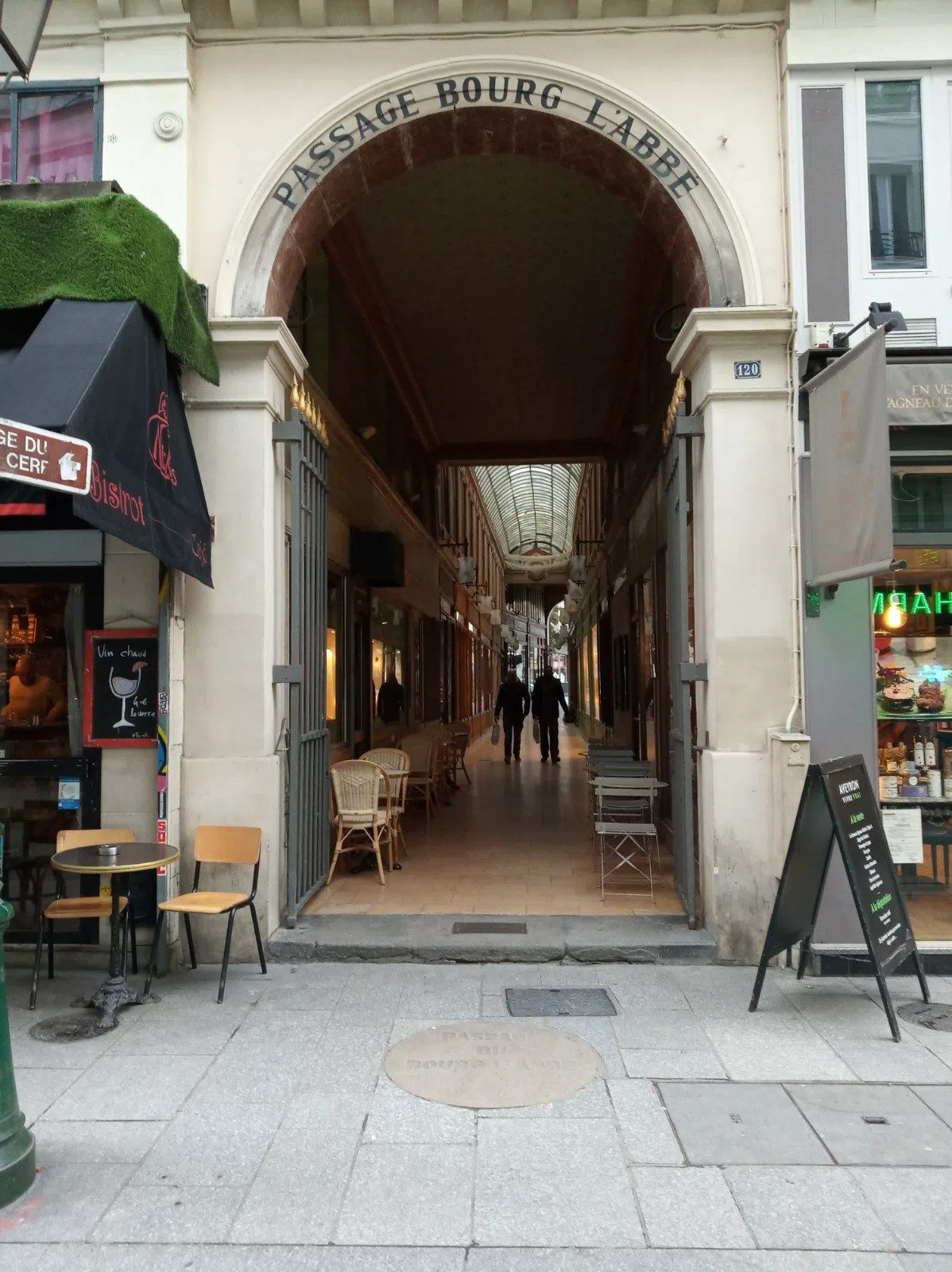
Almost directly across the street is Passage du Bourg-l'Abbé (near Montorgueil, 2nd), a gently faded gem you could walk past without noticing. It is short and quiet, with few shops, so treat it as a look-and-photograph stop rather than a shopping one: go for the sculpted caryatid doorway and the hushed, time-capsule hush of a place the twenty-first century mostly forgot. A small group passes through in a couple of minutes and comes out the far side feeling they've seen something the guidebooks skimmed.
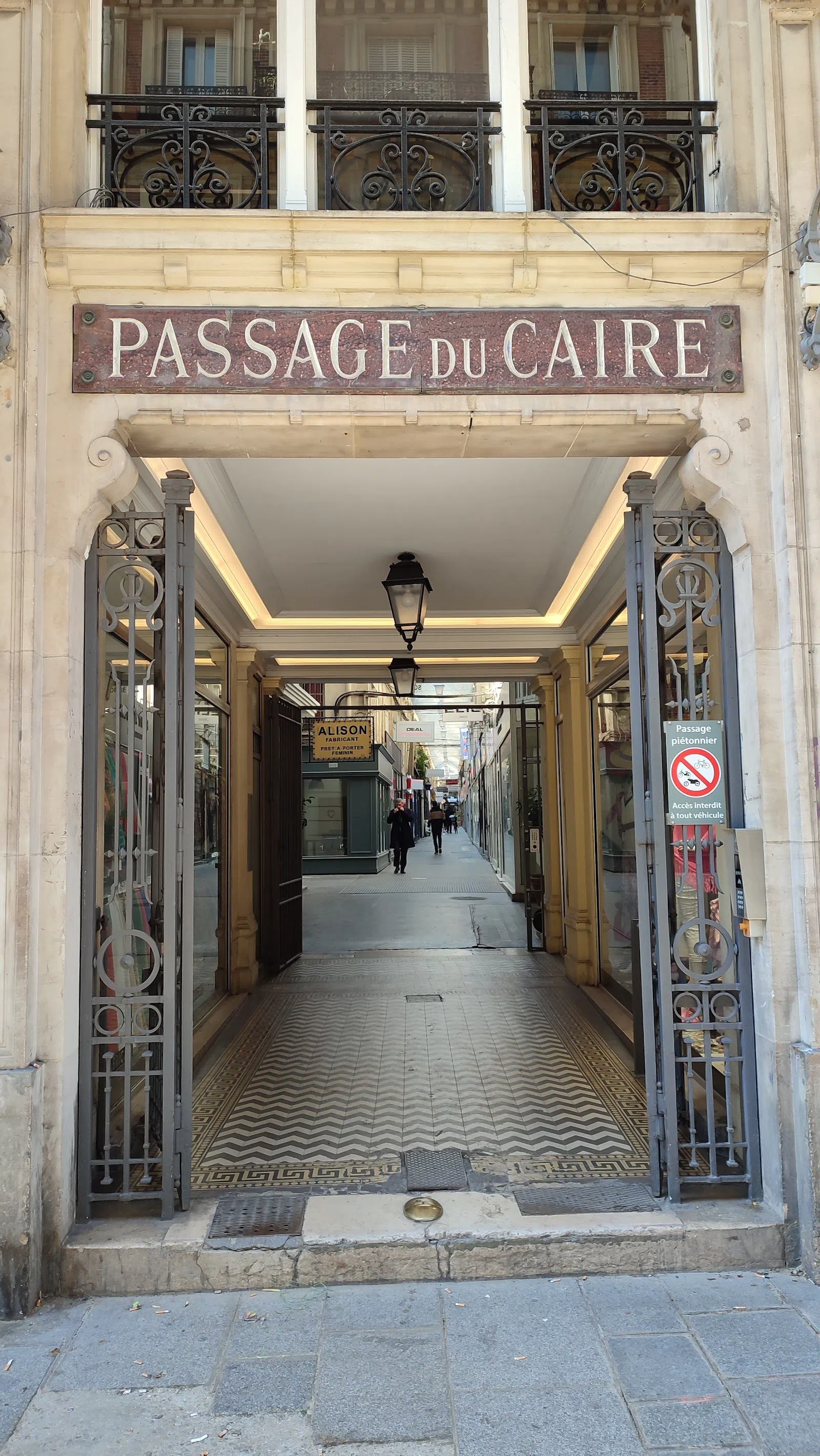
A little further into the Sentier lies the oddest and least polished of them all, Passage du Caire (the Sentier, 2nd) — the oldest and longest passage in the city, and emphatically not a shopping arcade. It runs through a working wholesale garment district, so on weekdays it is very narrow, very busy with trade, and almost entirely closed to ordinary retail. Come here for the extraordinary Egyptomania entrance — pharaonic heads and hieroglyphic mouldings, a souvenir of Napoleon's Egyptian campaign — and for the raw, un-touristy atmosphere of a passage still doing the job it was built for. Bring a small group, do a quick architectural look, and don't expect to buy anything or to find it open and calm on a weekday afternoon. Weekends, when the trade shuts down, are quieter and stranger. Include it as an honest contrast to the gilding elsewhere, not as a destination for browsing.
Two detours worth the walk: literature and a feast
The last two stops sit slightly off the tidy loop, and both reward the extra effort in different ways.
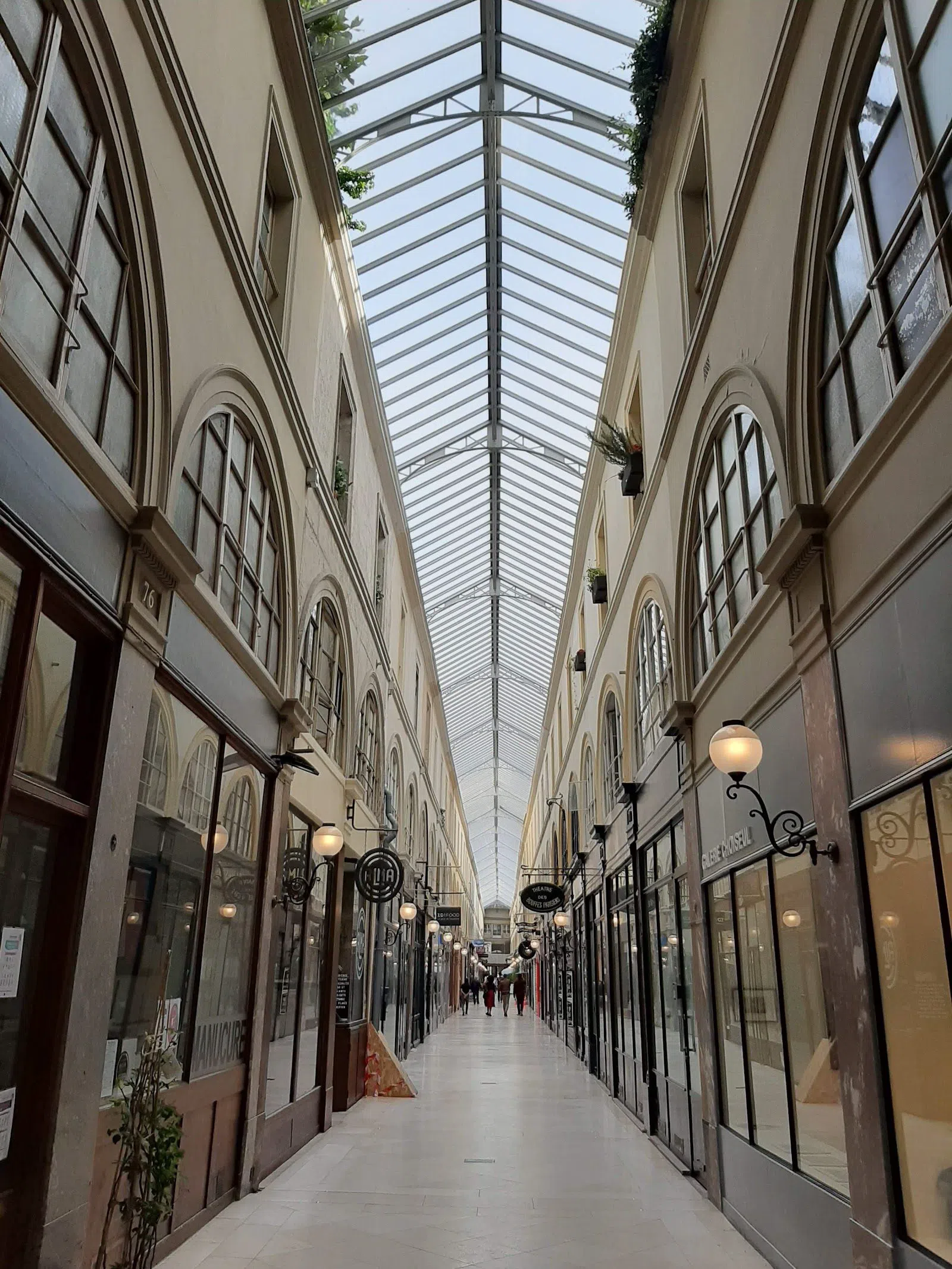
West toward the Opéra, Passage Choiseul (near rue Sainte-Anne, 2nd) is the longest of the central passages, restored and lively, with roomy proportions that let a group walk together without breaking formation. Its literary claim is real: the writer Céline grew up here, and the passage threads its length with mid-range shops and the odd theatre stage door. The eating is better just outside it — rue Sainte-Anne nearby is the city's Japanese and East-Asian canteen strip, with casual bistros in the €12–20 range that suit a hungry group looking for something quick and cheap rather than ceremonial. Use Choiseul as a long, well-lit walk-through with lunch options a step away.
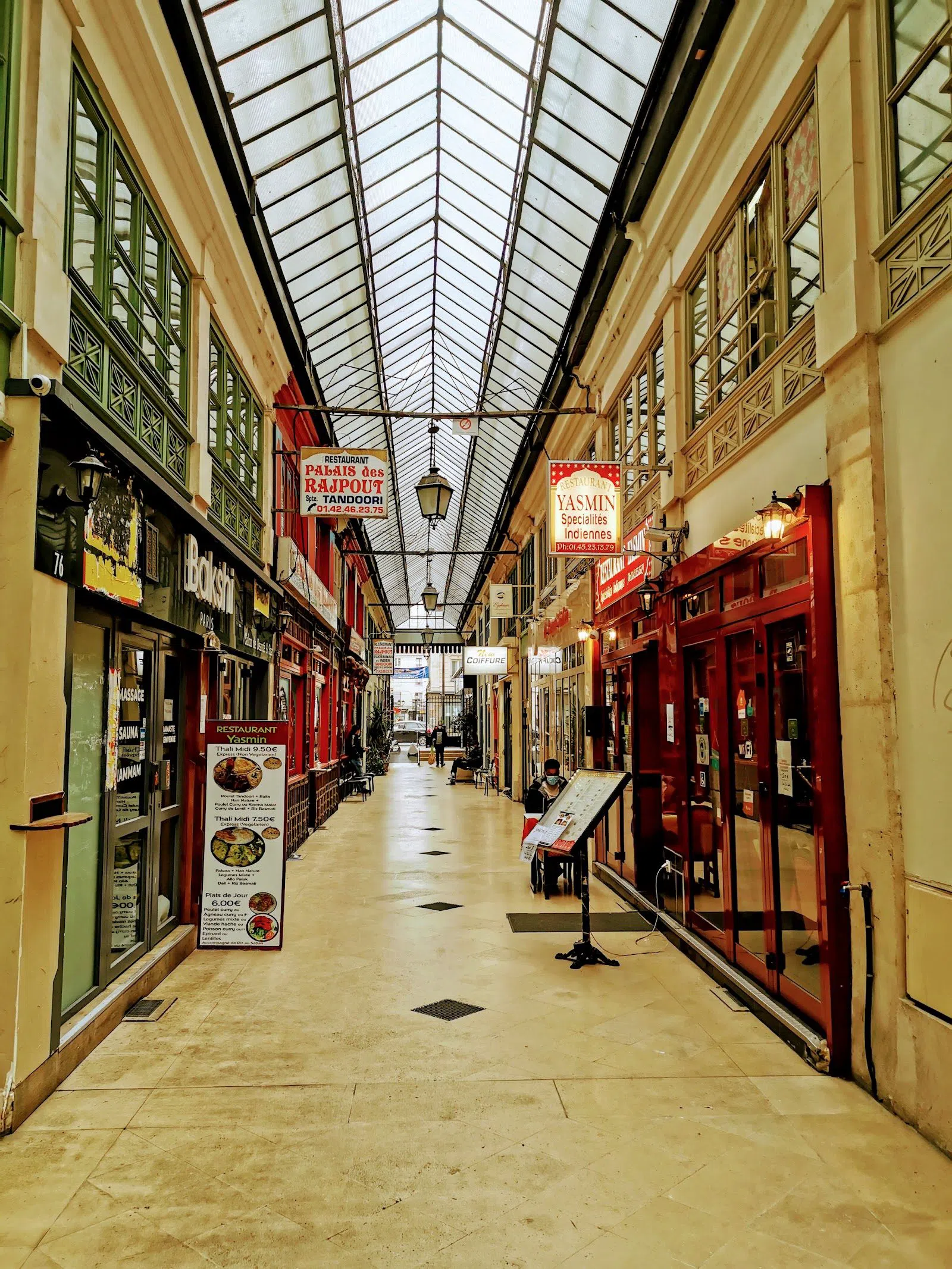
Finally, if you've built up an appetite and a crowd, make the walk east to Passage Brady (Faubourg Saint-Denis, 10th), the characterful outlier of the whole family. This is Paris's "Little India": a South-Asian food arcade rather than a boutique one, lined with Indian, Pakistani and Bangladeshi restaurants that actively court groups with set menus and generous thalis. Curry lunch menus run about €10–15 and dinner roughly €20–30, which makes it one of the best-value places in central Paris to feed a table of people well. The honest caveat is the touts: the corridor's restaurant hawkers can be pushy, so pick your spot, walk past the hard sell, and don't be steered. It is the opposite of Véro-Dodat in every way — noisy, cheap, unglamorous, generous — and a fitting, full-hearted place to end a day that began beside the Louvre under painted ceilings.
Practical notes: transport, cash, timing and budget
Getting around. The whole route is walkable — the point is to link the passages on foot rather than dip underground between them. If you'd rather split the day, Bourse or Grands Boulevards (Métro line 8/9) sits in the middle of the cluster, Palais Royal–Musée du Louvre (lines 1/7) anchors the western end, and Strasbourg–Saint-Denis (lines 4/8/9) is the stop for Passage Brady in the east. Wear shoes you can cover several kilometres in; the mosaic and stone floors are hard.
Cash and cards. Every passage is a public thoroughfare and free to enter — there are no tickets and no door policies. Cards are accepted almost everywhere, but keep a little cash for the antiquarian dealers in Verdeau, the smaller stalls in Panoramas, and the odd family restaurant in Brady, where a €10–15 lunch menu is sometimes simpler paid in notes.
Timing. Most passages open mid-morning and many shops close by 7pm, though the restaurants in Panoramas and Brady run late. Weekday mornings are calmest for browsing; Passage du Caire is only bearable for a look at the weekend, when its garment trade shuts. If you want the Musée Grévin in Jouffroy, book ahead — around €26.50 an adult — as walk-up queues build fast. Sundays see more shutters down but far fewer people under the glass.
Budget. The corridors themselves cost nothing, which is the joy of them. A comfortable day runs on a wine tasting or a glass at Legrand in Galerie Vivienne, a mid-range dinner in Panoramas or a plate at Le Pas Sage in Grand Cerf (€15–40), and a cheap, excellent feed in Choiseul's neighbouring canteens or a thali in Brady (€10–30). Boutique shopping in Véro-Dodat and Vivienne is where the numbers climb; you can happily do the entire route as a looking day and spend only on lunch.
For where to base yourself within walking reach of the arcades, start with a Paris hotel search, and for the wider city — museums, neighbourhoods and the rest — see the full Paris guide. Walk it as Balzac's characters did: slowly, with time to read the shop signs, and an eye for the rain the glass keeps off.
Before you go
What are the passages couverts in Paris?
They are 19th-century covered shopping arcades — glass-and-iron roofed corridors lined with boutiques, bookshops and restaurants. Around a dozen survive in central Paris, including Galerie Vivienne, Passage des Panoramas and Passage du Grand Cerf. All are public thoroughfares that are free to walk through.
Can you walk all the main Paris arcades in one day?
Yes. The passages cluster between the Louvre, the Grands Boulevards and the old Sentier garment quarter, so most can be linked on foot without the Métro between stops. A relaxed circuit runs from Galerie Véro-Dodat and Galerie Vivienne up to Panoramas, Jouffroy and Verdeau, then back to Grand Cerf, with Passage Brady as an eastern detour for dinner.
Which passage is best for a group versus a couple?
For groups, Passage du Grand Cerf is the most comfortable to browse thanks to its height and width, Passage Jouffroy suits mixed ages with the Grévin waxworks, and Passage Brady offers the best-value group dining. Compact, refined spots like Galerie Véro-Dodat suit a couple better, and tiny Passage des Deux Pavillons is just a connector.
Do I need to book restaurants in the Paris arcades?
For Passage des Panoramas, yes — its bistros and wine bars are tiny and fill fast at peak dinner hours, so a group without a reservation will often be turned away. Le Pas Sage in Grand Cerf and the wax museum in Jouffroy also take bookings, and Brady's restaurants welcome groups with set menus.
Are the Paris passages couverts free to enter?
Every passage is a public street and free to walk through, with no tickets or door policies. You only pay for what you buy — a glass of wine, a meal, or shopping — plus attractions like the Musée Grévin in Passage Jouffroy, which costs about €26.50 for an adult in 2026.