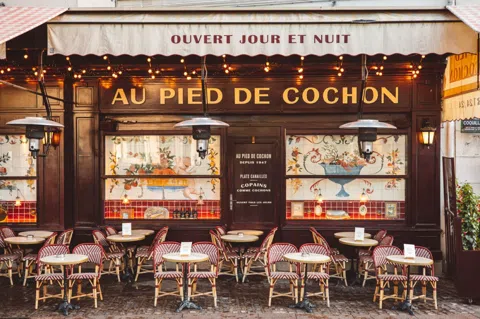
The Paris issue
The Paris Restaurants That Outlasted Their Kings
Sixteen Paris dining rooms have outlasted kings, empires, sieges and occupations. Here is how to eat your way through four centuries of them in a single weekend, with the prices, the door policies and a route you can walk.

By Sasha LindholmThe unhurried side of Paris
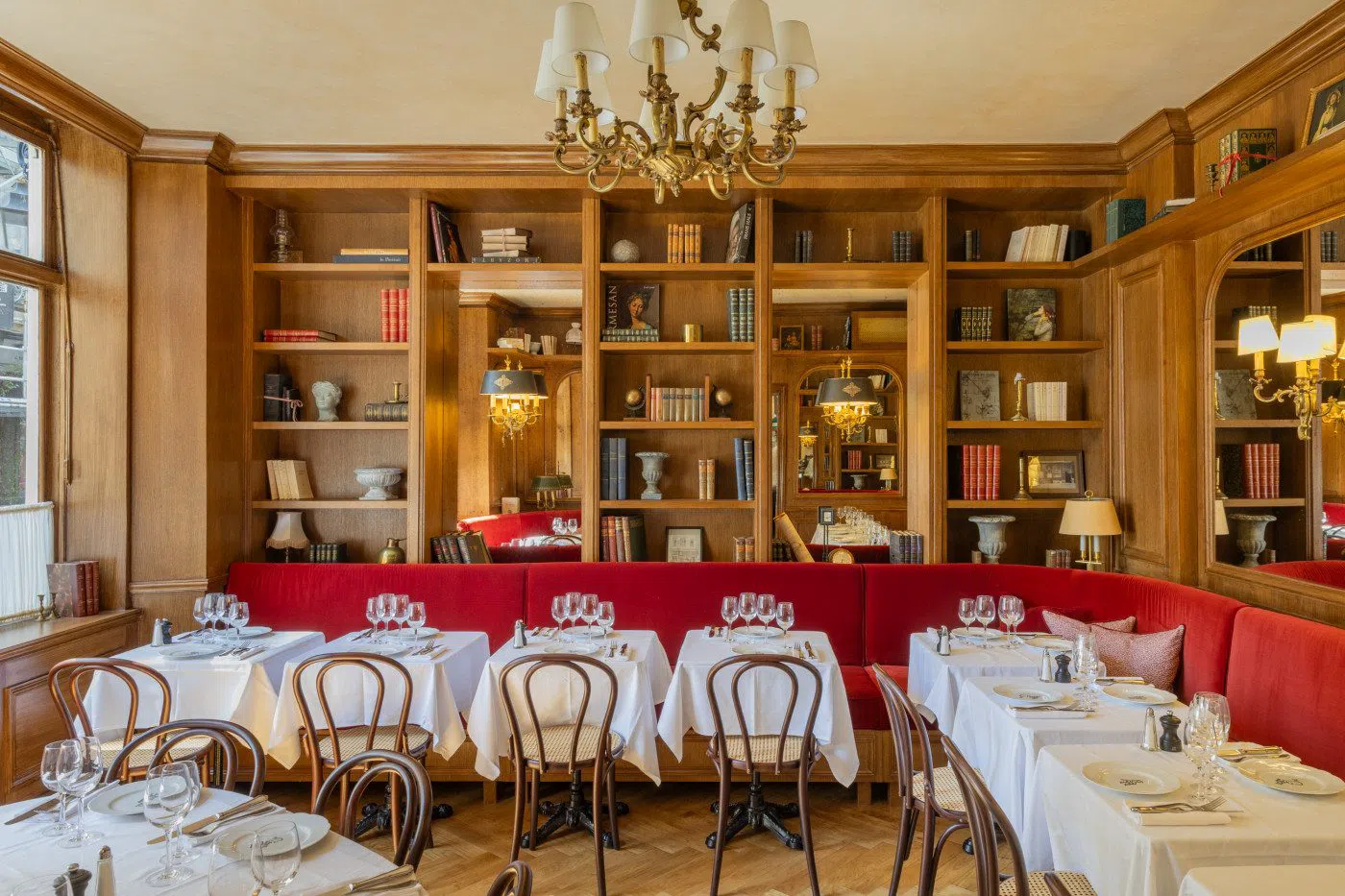
Paris has changed its form of government roughly a dozen times since a dining room opened behind a courtyard door on rue de Grenelle in 1680, and that room is still pouring wine at lunchtime. Kings, two empires, five republics, a commune, a siege and two occupations have passed over these floors, and at a handful of addresses the tables were simply wiped down afterwards and re-laid. What follows is a walkable trail through the restaurants that outlived the regimes that taxed them: what they cost now, which ones will actually let you in, and which are worth the detour rather than the photograph.
The oldest house in Paris still serves lunch
Auberge Nicolas Flamel (Le Marais, rue de Montmorency) occupies the oldest house in Paris, put up in 1407 by the scrivener whose name later got attached to four hundred years of alchemical rumour. The stone doorway and the beams are original, and so, unusually for a building this old, is the cooking. Alan Geaam has run it since 2019 and has held a Michelin star here since 2022, working a modern French register with Lebanese inflections. Tasting menus land between €90 and €150.

The practical catch is size. This is a narrow medieval house with a small dining room, which makes it ideal for two, workable for four to six, and genuinely difficult for a party of ten unless you arrange private hire well in advance. Book ahead; it is not a room that absorbs walk-ins. If you only eat one meal on this trail where the history and the plate are equally serious, make it this one.
Plan your Paris trip
Live prices from our booking partners.
Free cancellation on many rooms. We may earn a commission when you book.
Four Left Bank rooms that predate the Revolution
La Petite Chaise (7th, rue de Grenelle) is the address that has been in continuous service the longest, trading since 1680 and still recognisably a neighbourhood dining room rather than a heritage exhibit. The set three-course menu runs about €38 to €45, and you get dark wood, close tables and a small upstairs room that takes a group of six or eight comfortably. It closes Sundays and Mondays, the room is genuinely tiny, and it fills with locals, so book. Turning up on spec at 8pm on a Saturday will not work.


Le Procope (6th, Odéon) opened in 1686 as a coffee house and became the argument room of the eighteenth century. Voltaire, Diderot and later Robespierre all held forth here. It is the most visited name on this list and prices reflect it: mains roughly €24 to €38, set menus around €35 to €45. The group offer is what justifies the money. Five private salons, named for Franklin, Diderot and Lafayette among others, mean you can put twelve people in a room with a door, which almost nothing else this old can do. It is open daily from noon to midnight. Façade restoration work runs into mid-2026; the restaurant stays open throughout, so ignore the scaffolding.
Lapérouse (6th, quai des Grands Augustins) has been trading since 1766 on the river side of the street, and its salons privés are the most cinematic rooms on the trail: small, red, gilded, and lined with mirrors scratched by generations of guests testing whether the diamonds they had just been given were real. Mains run €40 to €60 and dinner passes €100 a head without effort. There is a dedicated desk for parties of nine or more ([email protected]), and for a group the private salons are the entire point; in the main room you are paying the same money for a fraction of the drama. Closed Sundays and Mondays.
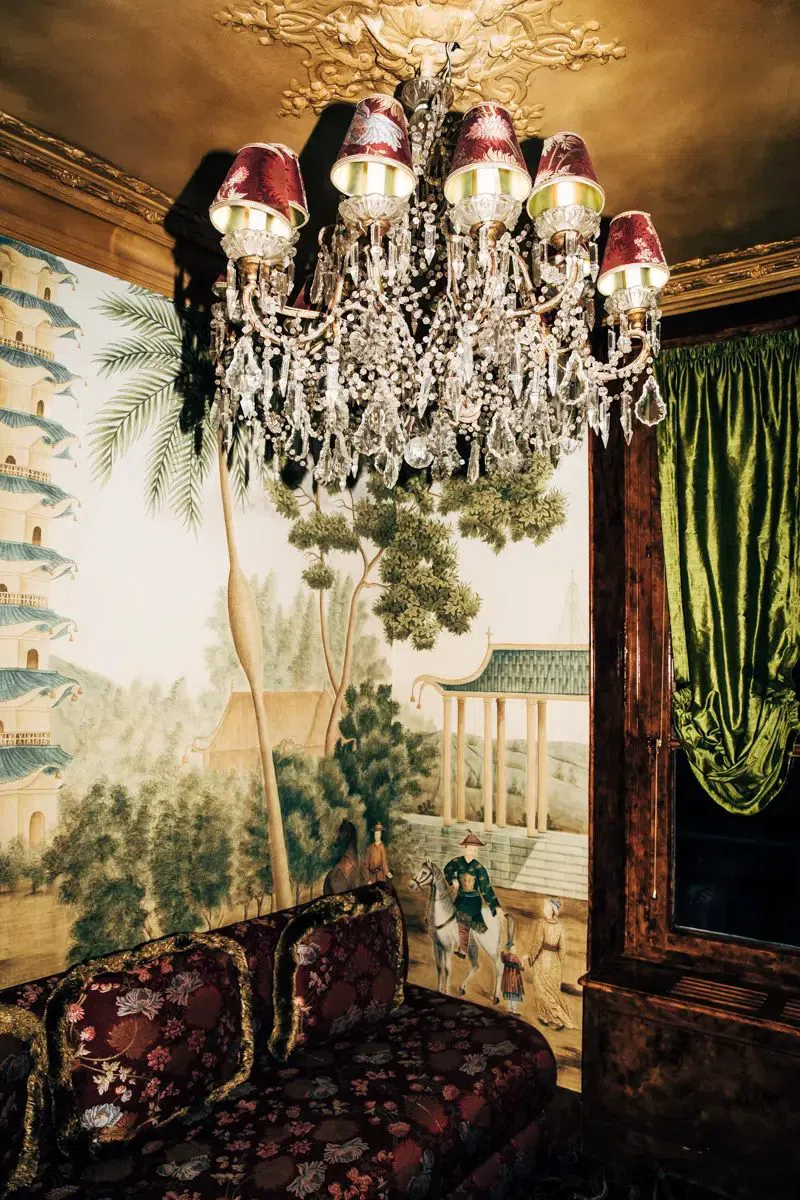

La Tour d'Argent (5th, quai de la Tournelle) traces its site to 1582 and looks down on the flying buttresses of Notre-Dame from the top floor. It reopened in 2024 after an eighteen-month restoration and holds one Michelin star in the 2026 guide, which matters here, because plenty of old rooms coast on the view and this one does not. The pressed duck still arrives with its numbered certificate. Tasting menus start north of €300, the lunch menu is materially cheaper and is the honest way in, a jacket is expected, and there is no such thing as walking in. Book weeks out and take the reservation you are given. It also does private dining and salon hire if you are marking something.
Those four sit inside a twenty-five minute riverside walk of one another, which makes them a single afternoon's reconnaissance even if you only eat at one.
One Palais-Royal dining room under new management
Le Grand Véfour (1st, under the Palais-Royal arcades) has been open since 1784, and the painted glass panels, mirrors and banquettes are a listed monument, legally unchangeable, which is why the room survived a handover that would have gutted anywhere else. In late May 2026 it relaunched under Paris Society with chef Bruno Doucet, after Guy Martin's thirty-four years in the kitchen. The interior came through intact; the cooking is being rebuilt in public, so go with curiosity rather than a fixed expectation.

Pricing is full fine-dining, with lunch the softer entry point. The room is compact and protected, so a large party needs arranging in advance rather than assuming; it is bookable for private events. For two people who want the eighteenth century without the tour groups, come to the arcades at dusk.
Where the writers actually ate
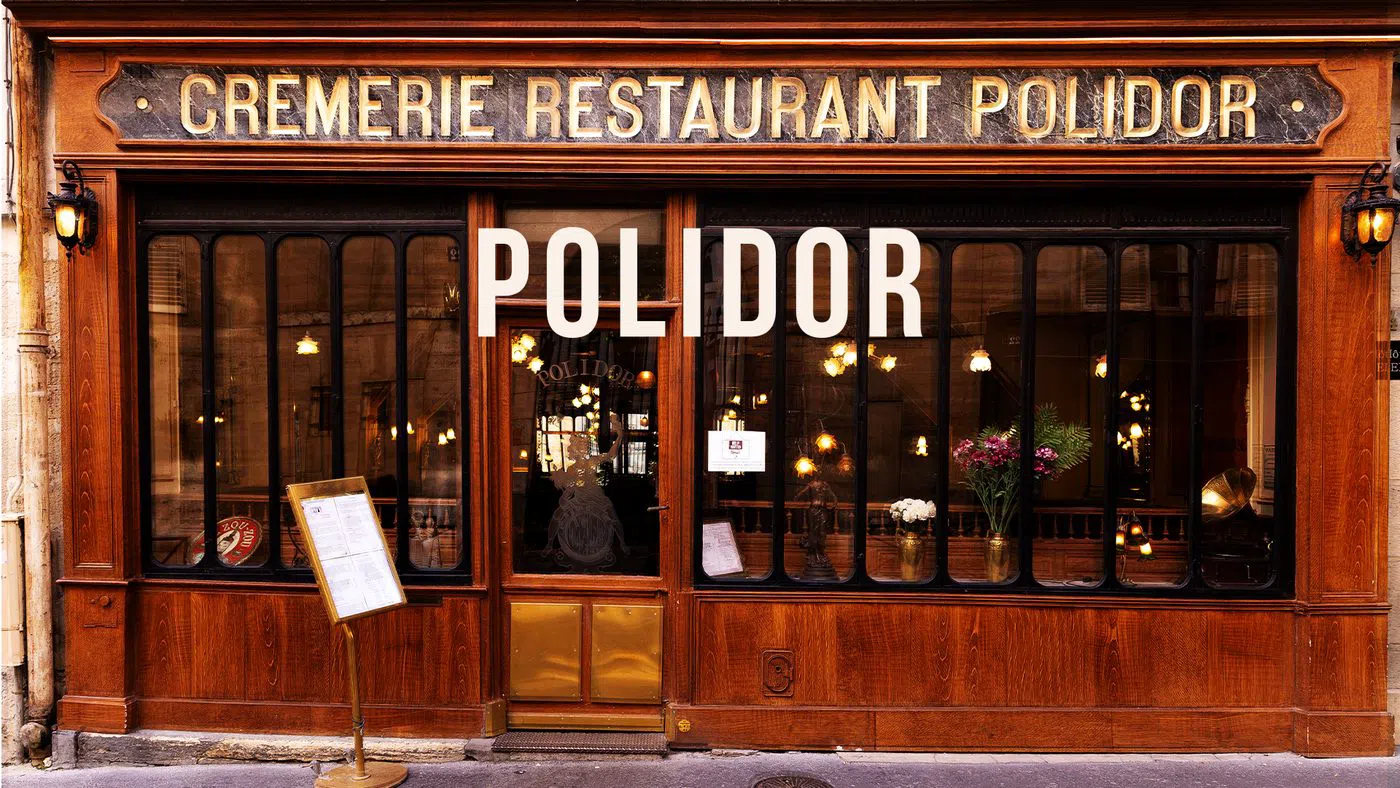
Polidor (6th, rue Monsieur le Prince) started as a crémerie in 1845 and turned bistro in 1890, and almost nothing has been done to it since: the same tiled floor, the same numbered drawers where regulars once kept their napkins. Joyce, Rimbaud and Kerouac ate here, and Woody Allen's cameras found it a century later. Mains sit around €14 to €22 with menus from about €25, it opens every day of the year, and it prefers cash. Communal tables mean a group of six is normal and a couple should expect neighbours. This is the cheapest genuine time capsule in the city and the one place on the trail where the bill will not make you flinch.
La Closerie des Lilas (Montparnasse, boulevard du Montparnasse) has been open since 1847 and is where Hemingway wrote, at a bar that now carries small brass plaques naming the writers who drank at each spot. Three distinct operations share the address: brasserie, restaurant and piano bar. Eat on the brasserie side, where mains run €28 to €45, rather than in the pricier restaurant. The terrace seats a crowd and the place is comfortable with groups. Find your plaque, order simply, and stay for the piano.

Brasserie Lipp (6th, boulevard Saint-Germain) opened in 1880, founded by Alsatian refugees, and has been the canteen of French publishing and politics ever since. Mains are €28 to €40. Be clear-eyed about the door: the ground floor takes no reservations at peak, seating is at the staff's discretion, and Lipp is famously unsentimental about where it puts you. The ground-floor room among the ceramics is the one you came for; upstairs is exile. Go early, go in a pair, and treat being seated well as a bonus rather than a right.

What the Alsace exodus put on Paris plates
The brasserie is an import with a date, not an ancient Paris institution. After 1870 and the loss of Alsace, families moved west in numbers and brought beer, choucroute and long zinc counters with them, and inside a generation they had rewritten the way Paris eats late at night.
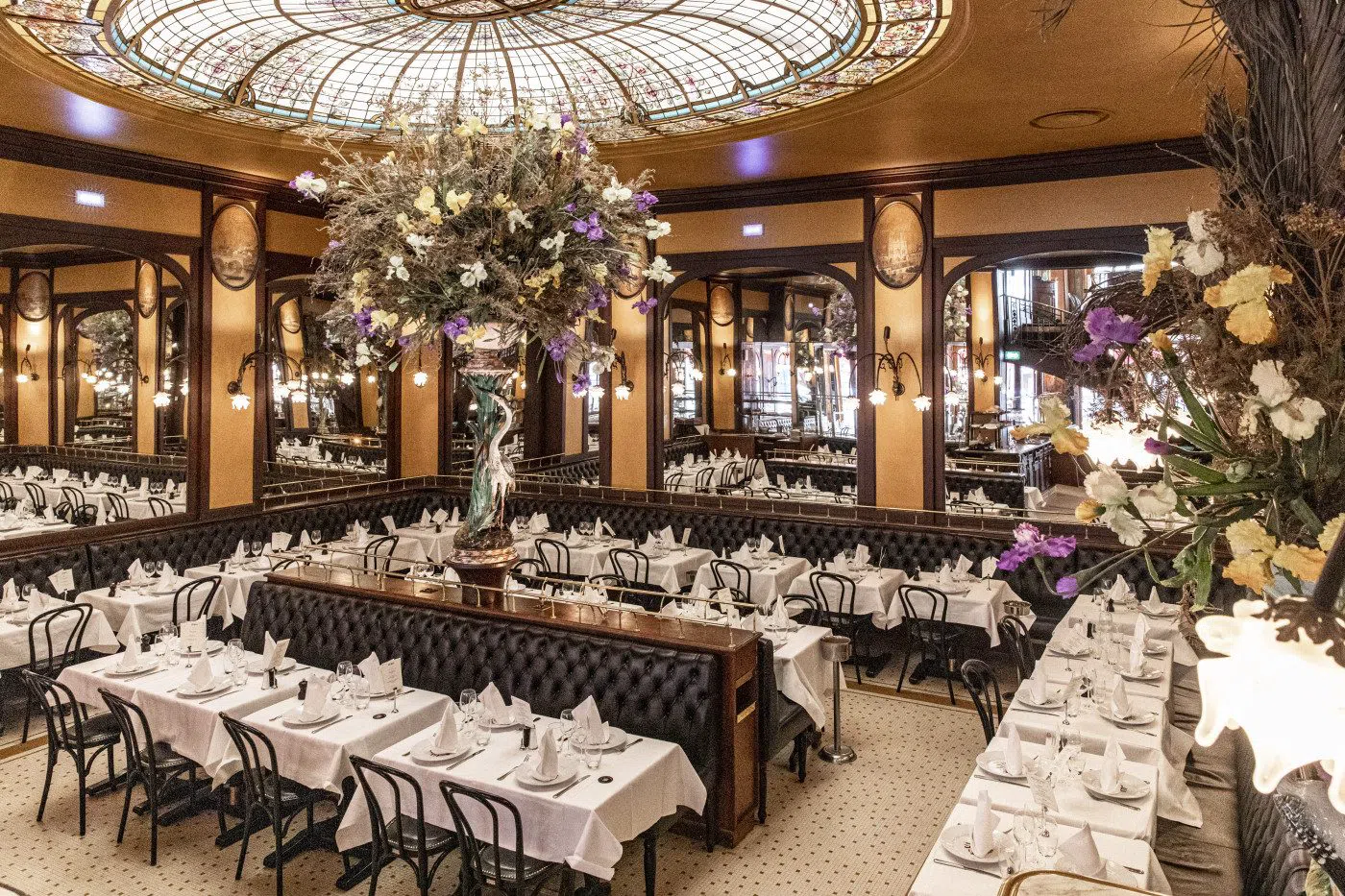
Bofinger (4th, rue de la Bastille) is the clearest illustration, open since 1864 and the city's oldest Alsatian brasserie, with a stained-glass dome over the ground-floor room that is worth asking to sit under. Mains are €24 to €38 and the house order is the choucroute. It was built for volume, so it takes groups readily, does private hire, and opens daily, which makes it the most reliable Sunday-night table on this whole list. Lipp, a few minutes across the river, is the same story told with more attitude and a higher bill.
Belle Époque rooms built for a crowd

Au Petit Riche (9th, rue Le Peletier) was founded in 1854 to feed the coachmen waiting on the Opéra, and has barely been altered: brass, mirrors, banquettes, and a layout that is really a run of separate salons rather than one room, several of which can be taken privately. Set menus are roughly €36 to €45, it opens seven days, and a Loire-heavy list of more than three hundred mostly organic wines keeps it from being pure nostalgia. For a dinner of eight to twelve where everyone still wants to hear each other, it is the best value on the trail.
Brasserie Mollard (8th, rue Saint-Lazare, opposite the station) dates from 1895 and is a listed monument covered floor to ceiling in mosaic and glass, arguably the most spectacular surviving Art Nouveau interior in the city, and far less crowded than the Left Bank names because it sits in a commuter district nobody thinks of as a dining destination. Mains run €26 to €42 and seafood platters push it higher. It has an explicit seminars-and-banquets offer, opens every day, and serves continuously, so a late-afternoon arrival is welcome.


Le Grand Colbert (2nd, rue Vivienne) sits beside the Galerie Colbert, which dates to 1826, with the brasserie itself arriving around 1900. It is a listed room and instantly familiar to anyone who has seen Something's Gotta Give. Mains are €26 to €42, service runs late, and the space is roomy and used to groups and private events.
Le Train Bleu (12th, Gare de Lyon) was built for the 1900 World's Fair and opened in 1901 by the President of the Republic, a station buffet that turned into a monument, with painted ceilings above the platforms and Michel Rostang's input in the kitchen. Mains are €32 to €48 with set menus available, the large-format rooms and bar lounges swallow groups, and it opens every day of the year. It is also the only restaurant here you can reach with luggage without embarrassment.

Two bouillons and the price of eating like 1896
The bouillons were the industrial answer to feeding working Paris: cheap broth and meat, fast service, no ceremony. Two survive in their original rooms.
Bouillon Chartier Grands Boulevards (9th, rue du Faubourg Montmartre) is the 1896 flagship and the one to list; the later siblings are pleasant but they are not this. Mains are typically €10 to €16 and a full meal comes in under €25, the order is scrawled on the paper tablecloth, and nobody takes reservations. Strangers are seated together at shared tables, which is the format rather than a mistake. Arrive at 11:30am or after 9:30pm to skip the queue; between those hours you will stand outside.

Bouillon Julien (10th, rue du Faubourg Saint-Denis) opened in 1906 and has been restored back to its Art Nouveau original after years spent as a pricier brasserie. Note that the current name is Bouillon Julien, not the old Brasserie Julien. Mains are roughly €10 to €17, it serves through the afternoon, it handles groups well, and it is far easier to get into than Chartier. If you want peacock-glass panels and a €14 main in the same sitting, this is the answer.

Walking the trail over a weekend
Day one is the Left Bank and it walks end to end: start at La Petite Chaise for lunch, cross to Le Procope and Polidor around Odéon, take the quai past Lapérouse, and finish looking at La Tour d'Argent from the Pont de la Tournelle whether or not you are eating there. Day two crosses the river: Palais-Royal for Le Grand Véfour and Le Grand Colbert, the Grands Boulevards for Chartier and Au Petit Riche, then east to Bofinger or Julien for dinner. Mollard and Le Train Bleu are the two worth building around a train.
Staying in the 1st, 2nd, 6th or 9th puts most of this within a twenty-minute walk; check the Paris hotel search for the arrondissement you want to wake up in, because the difference between a ten-minute walk home and a Metro change at midnight is the whole evening.
Practical notes before you book
Everything here is inside Metro Zone 1 and most legs are shorter on foot than underground. Buy a Navigo Easy pass and load carnets of t+ tickets, or use contactless on the barrier. The Metro runs until roughly 1:15am on weeknights and 2:15am on Friday and Saturday nights, which covers a late brasserie dinner but not a long one.
Cards are accepted almost everywhere, with Polidor the exception that prefers cash, so carry €60 or so for the day. Service is included in the price by law; leaving a couple of euros on a bistro table or rounding up a larger bill is normal and nothing more is expected.
Lunch service is roughly noon to 2:30pm and dinner from 7:30pm, with Parisians arriving from 8:30. The brasseries and bouillons serve continuously and are your friends at 4pm. Watch the closures: La Petite Chaise and Lapérouse both shut Sundays and Mondays, which is precisely when visitors have time. August thins the staffing citywide, and Le Grand Véfour is still settling in after its May 2026 relaunch, so confirm by phone rather than trusting an aggregator.
A day of this can cost €30 or €400. The honest floor is a bouillon lunch under €25 and a Polidor dinner around €30; the middle is €38 to €45 at La Petite Chaise or Au Petit Riche; the top is a tasting menu at La Tour d'Argent or Auberge Nicolas Flamel. A good compromise is one splurge and three time capsules: book the expensive room for lunch, where the same kitchen costs a fraction of dinner.
For eight or more, the reliable names are Le Procope, Au Petit Riche, Bofinger, Mollard, Le Grand Colbert and Le Train Bleu, all of which have real private rooms or the volume to absorb you. Lapérouse will take you through its group desk and put you somewhere unforgettable. Do not turn up at La Petite Chaise or Auberge Nicolas Flamel with a crowd and hope.
For everything else in the city, districts, seasons, what to do between meals, start with the Paris guide.
Before you go
What is the oldest restaurant in Paris?
It depends what you count. La Petite Chaise on rue de Grenelle has been in continuous service as a dining room since 1680, which makes it the oldest restaurant address still trading. Le Procope opened in 1686 as a coffee house. La Tour d'Argent traces its site back to 1582 but has not run unbroken as the same business, and Auberge Nicolas Flamel occupies the oldest house in Paris, built in 1407, though it has only been a restaurant in recent decades.
Which of these take walk-ins and which need booking weeks ahead?
Bouillon Chartier and Bouillon Julien take no reservations at all, and at Chartier that means queueing unless you arrive at 11:30am or after 9:30pm. Polidor, Bofinger, Le Grand Colbert and Le Train Bleu can usually seat you at short notice. Brasserie Lipp's ground floor is walk-in, though the staff seat you at their own discretion. La Tour d'Argent, Le Grand Véfour, Auberge Nicolas Flamel, Lapérouse and La Petite Chaise all need booking well in advance.
Can I do this trail on a modest budget?
Yes. Bouillon Chartier and Bouillon Julien keep mains at €10 to €17 and a full meal under €25, Polidor runs €14 to €22 for mains with menus from about €25, and La Petite Chaise does a three-course set menu at €38 to €45. Two bouillons and one bistro give you 1845, 1896 and 1906 in the same day for well under €80 a head. If you want one expensive room, book it for lunch, when the same kitchen costs a fraction of the dinner price.
Are any of these good for a group of eight or more?
Several. Le Procope has five private salons, Au Petit Riche is a run of separate rooms that can be taken privately, and Brasserie Mollard markets itself for banquets and seminars. Bofinger, Le Grand Colbert and Le Train Bleu were all built for volume. Lapérouse runs a desk for parties of nine or more at [email protected], and its private salons are the reason to go. Do not book a crowd into La Petite Chaise, Auberge Nicolas Flamel or Le Grand Véfour without arranging private hire first.
Which historic Paris restaurants open on Sundays and Mondays?
Le Procope, Bofinger, Au Petit Riche, Brasserie Mollard, Le Grand Colbert, Le Train Bleu and Polidor all open seven days, and Polidor and Le Train Bleu open every day of the year. Bouillon Julien serves straight through the afternoon. La Petite Chaise and Lapérouse are closed both Sundays and Mondays, so plan those two for midweek.