The Paris issue
The Marble Counter: Eating Paris One Market Stall at a Time
A stall-by-stall walk through Paris's markets, covered halls and food streets — with the prices, opening days and group realities nobody tells you before you arrive hungry.
By Leïla HaddadParis by the plate and the market stall
The first thing you learn, eating your way across Paris, is that the city keeps its best tables outdoors and under glass — not behind velvet ropes. A rotisserie chicken turning gold under a market lamp, an oyster shucked to order while you dig for coins, a wedge of Comté cut exactly to the nod you give across the counter: this is how Parisians actually feed themselves, and it beats most of the restaurants tourists queue for. What follows is a stall-by-stall, hour-by-hour walk through the markets, market streets and food halls I keep returning to — with prices, opening days, and honest advice on where six people will thrive and where two is already a crowd.
I have a rule: I won't send you somewhere I haven't eaten at twice. Everything below has passed that bar. What it can't do is bend the calendar for you — half the joy and half the frustration of market eating in Paris is that the good stuff runs on specific days and specific hours, and a wrong guess leaves you in front of shuttered stalls. So read the days before you plan the walk.
Under glass: the covered halls
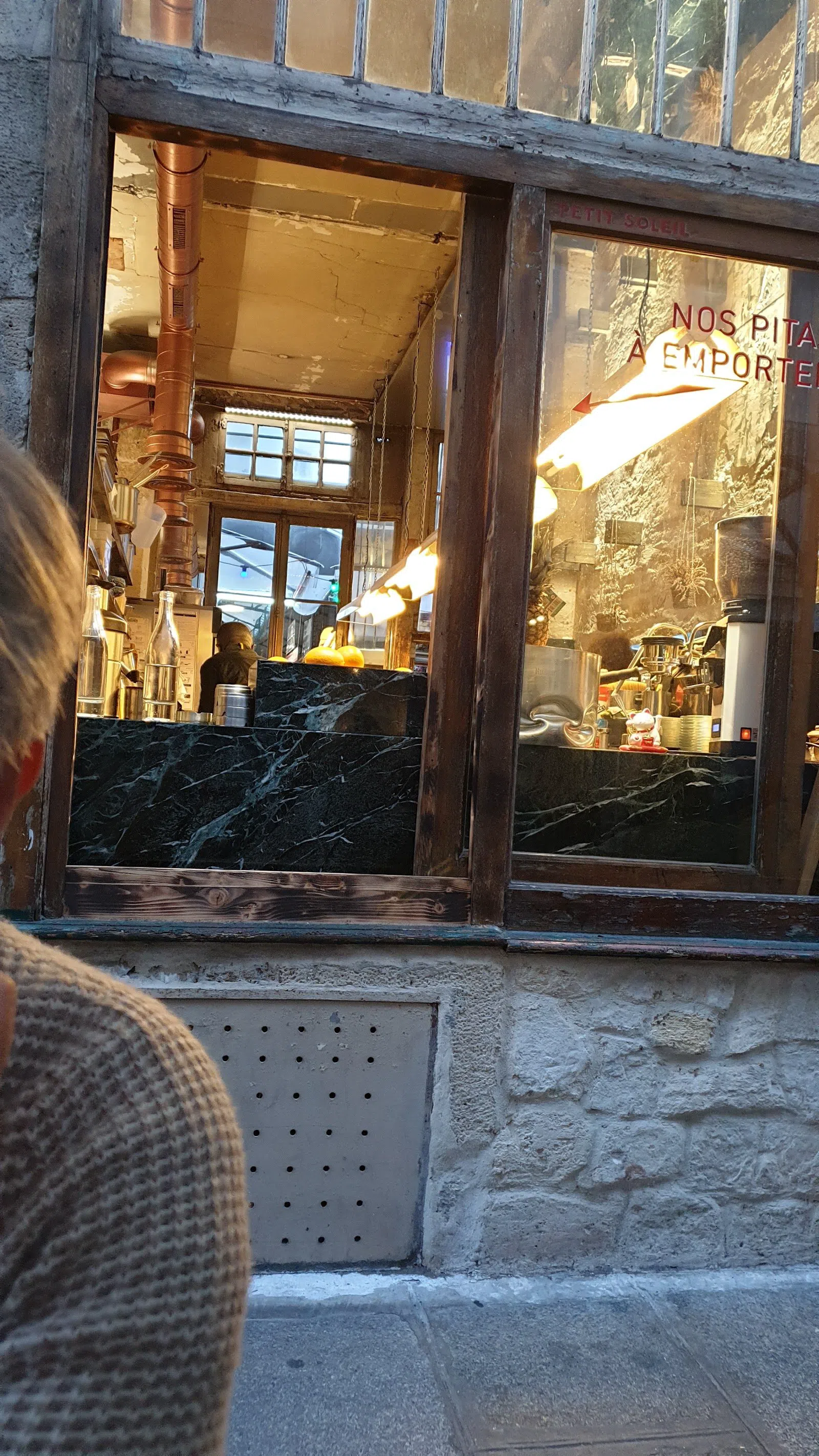
Start with the covered markets, because they are the most forgiving — weatherproof, walk-in, and open more days than the street markets. The pick of them, and the one I'd open any food crawl with, is Marché des Enfants Rouges in the Marais (3rd). It's the oldest covered market in the city and it plays as a small, jostling international food court: Moroccan tagines, Japanese bento, Italian plates, galettes, most cooked dishes landing between €8 and €16. It's walk-in only, no reservations, and here's the honest part — the shared tables and standing counters get swamped at lunch. It's at its best for two to five people; a group of eight will fracture and spend the meal shouting across strangers. Go before noon or roll in mid-afternoon when the counters breathe again, order from the stall with the longest local queue, and eat standing if you have to. It's worth the elbows.
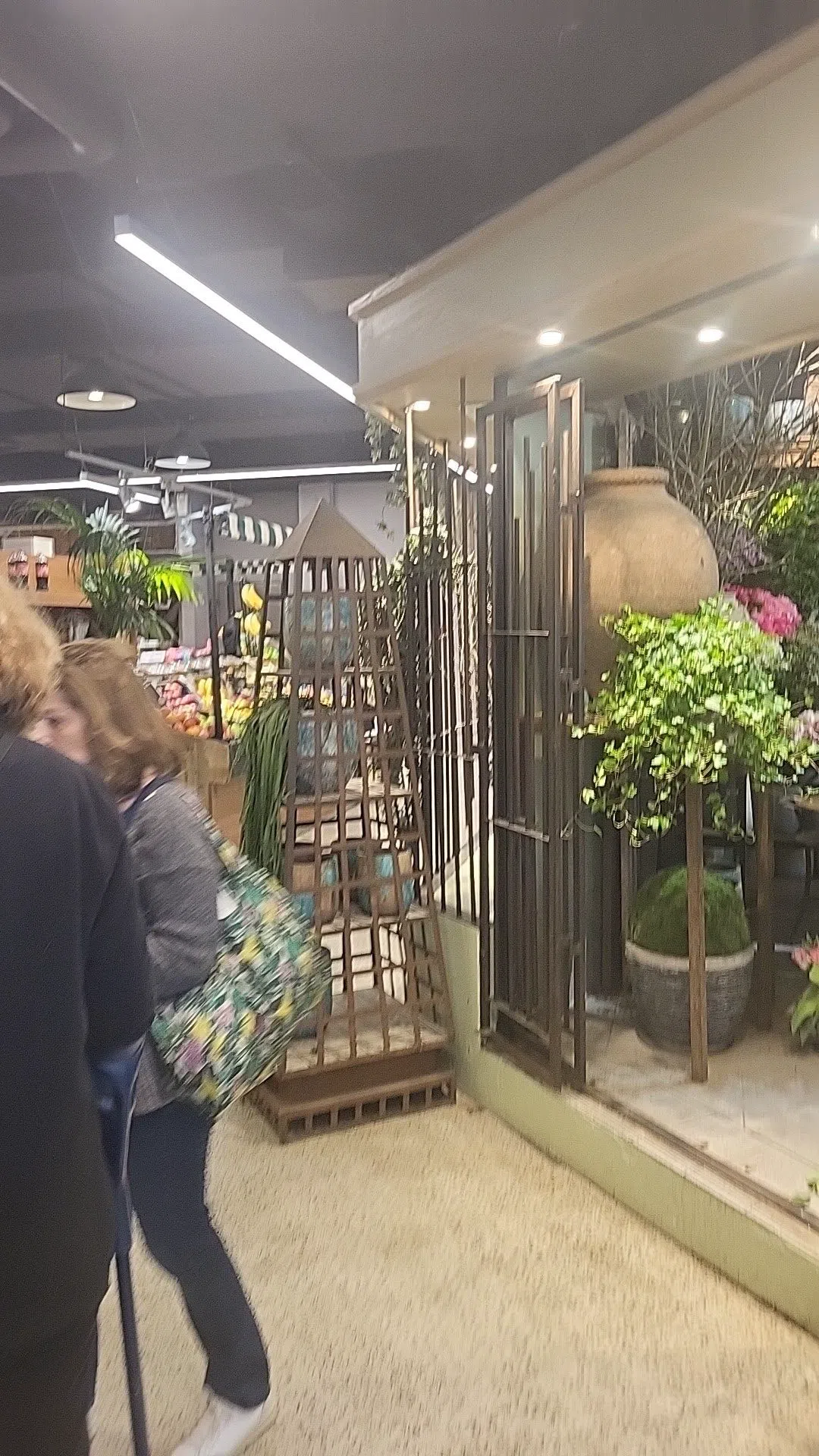
When the sky opens — and in Paris it will — I point people to Marché Saint-Quentin near the northern stations (10th). It's a handsome iron-and-glass hall, less touristy than the Marais, with proper sit-down counters built into the market itself, so you can settle in with a plate and a glass rather than juggle a paper tray. It runs six days a week (closed Monday), prices sit in the € to €€ band, and it's the most reliable rainy-day plan on this list — especially useful if you're arriving footsore off a train and want to eat well within a five-minute walk of the platform. Small-to-mid groups fit comfortably; it never feels like a scrum.
Plan your Paris trip
Live prices from our booking partners.
Free cancellation on many rooms. We may earn a commission when you book.
Reading the calendar: the open-air markets
Now the street markets, where Paris shows its real face. These are the ones worth building a morning around, but each keeps its own hours, so match the market to your day.
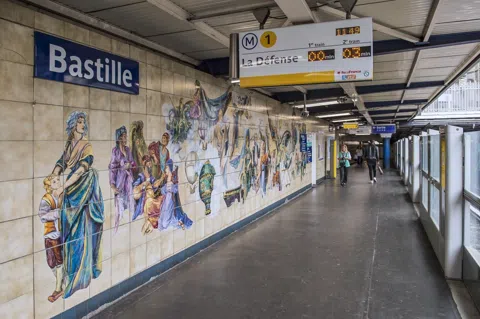
For raw, unfiltered energy, nothing beats Marché d'Aligre & Marché Beauvau near Bastille (12th). It's two markets fused into one — a rowdy open-air street run of fruit, veg and bric-a-brac feeding into a covered hall of butchers, cheesemongers and a legendary little wine counter. It's the cheapest produce in central Paris, bartering is not just tolerated but expected on the open-air stalls, and the whole thing hums loudest on weekend mornings when the banter turns theatrical. It's closed Mondays. This is a grazing market, not a sitting one — buy a wedge of cheese here, a fistful of cherries there, a slice of something roasted, and eat as you walk, because seating is scarce. Perfect for a self-guided group that wants to assemble a picnic on the hoof.
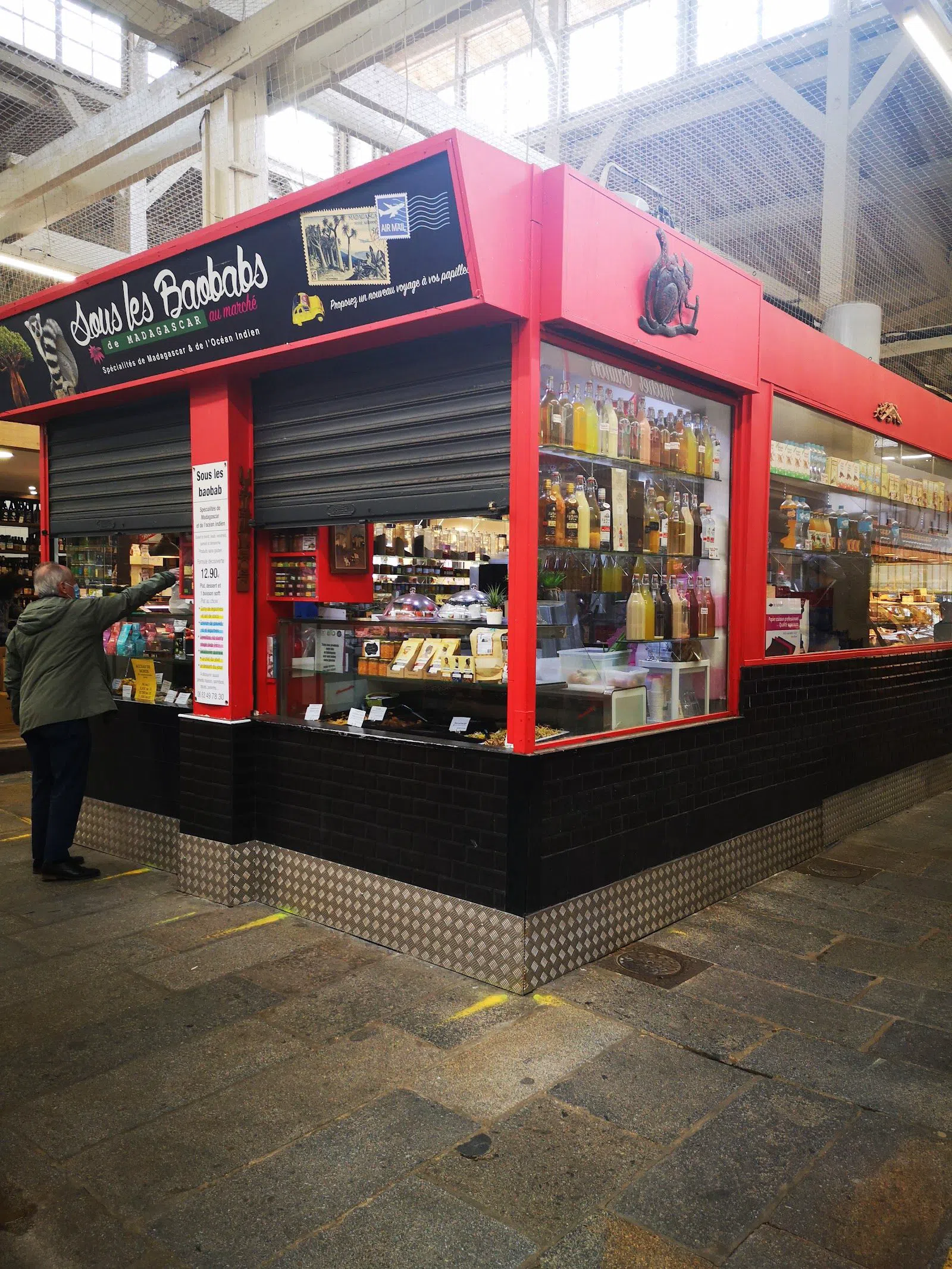
If you want scale and photographs, time your visit to Marché Bastille, which sprawls down the boulevard Richard-Lenoir (11th) on Thursdays and Sundays, roughly 7am to 3pm. It's one of the biggest and most photogenic open-air markets in the centre — oyster and seafood counters where a dozen with a glass of Muscadet runs €10–20, cheese pyramids, flowers, the lot. The width of the boulevard means it genuinely absorbs large groups and walking tours without bottlenecking, which is rare. Arrive after 8:30am, once the stalls are fully dressed and the crowd has arrived to make it buzz; turn up at opening and you'll catch vendors still unloading crates.
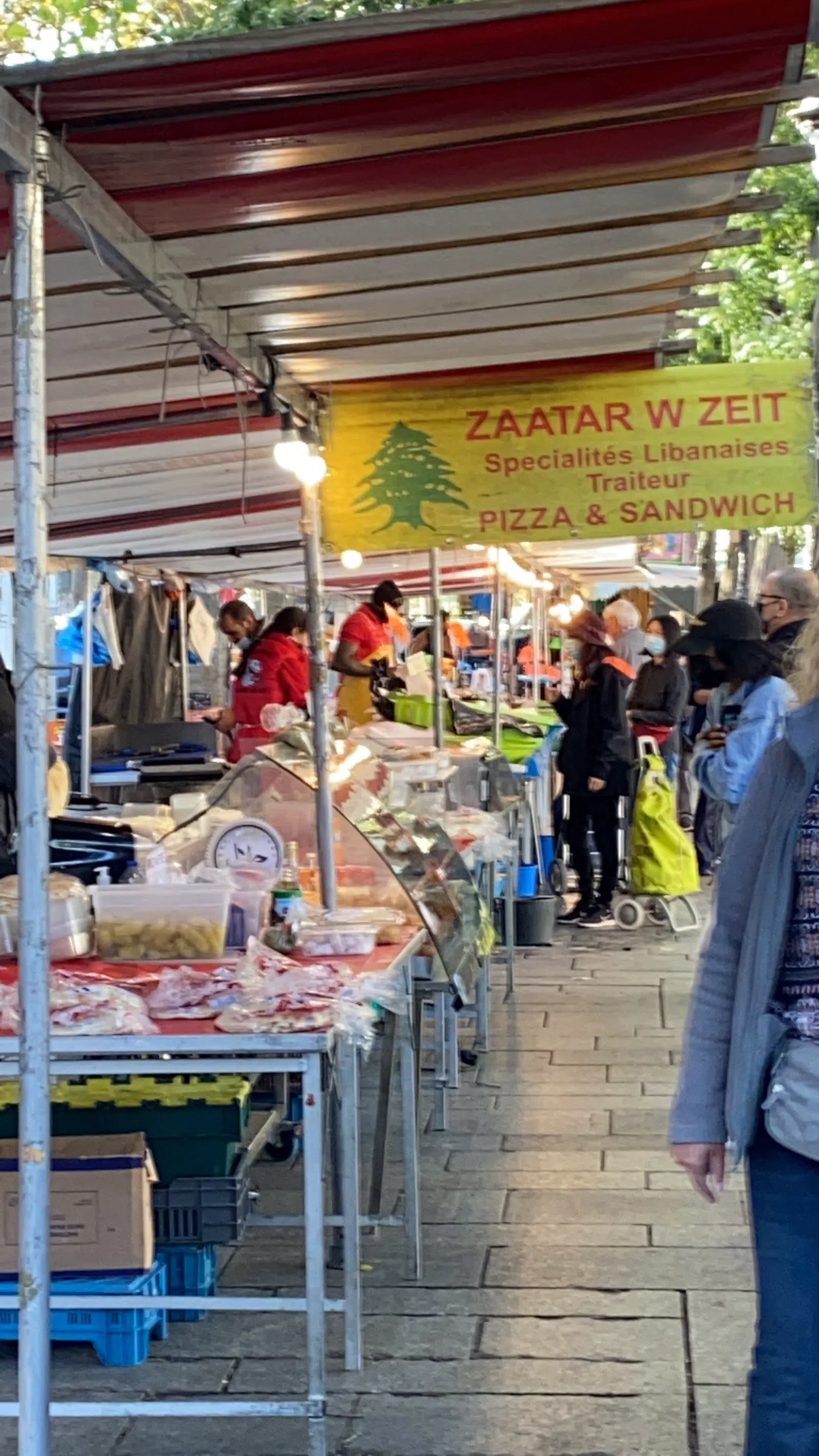
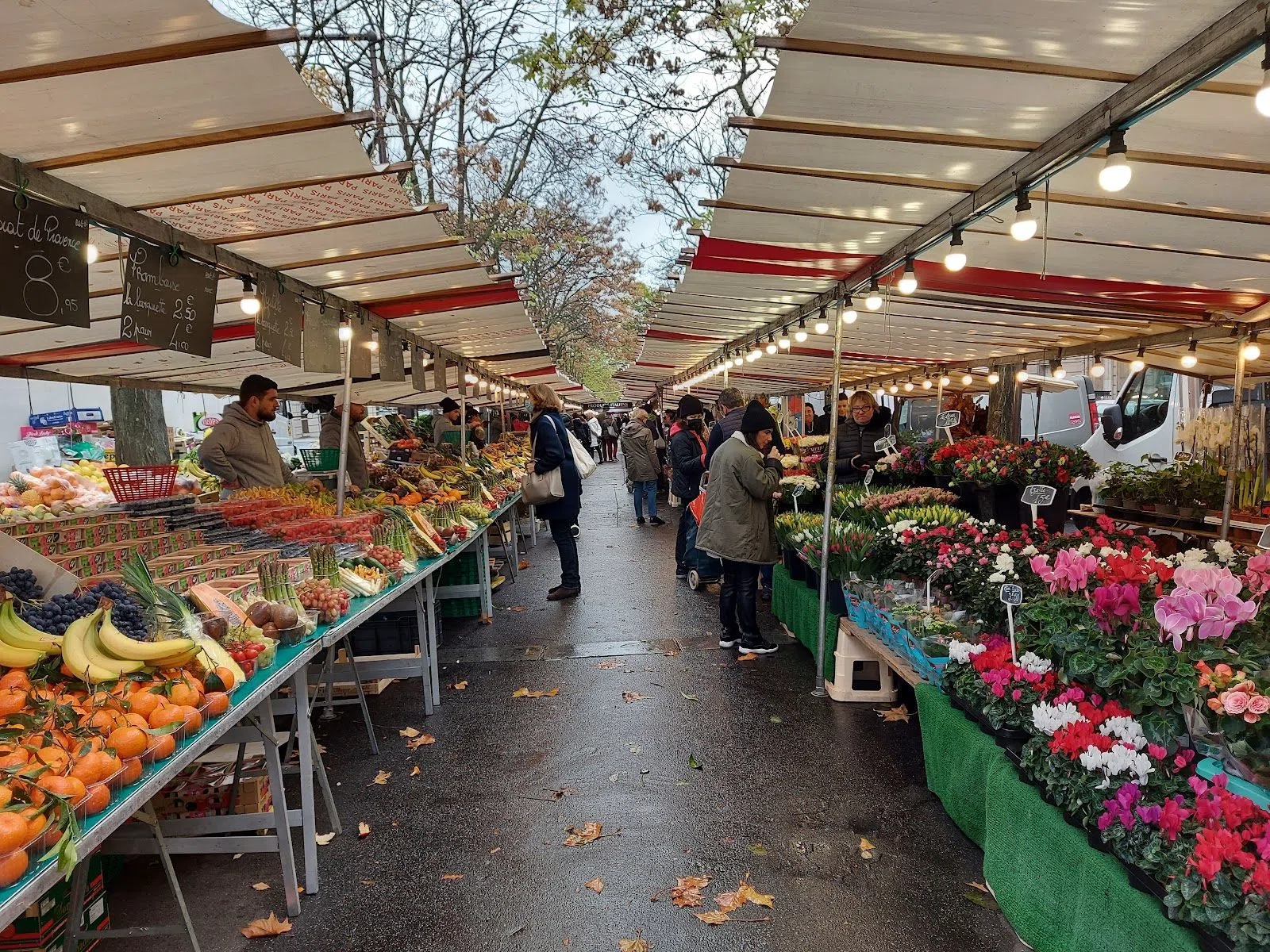
For a different register — quieter, richer, more serious — there's Marché Président Wilson near the Palais de Tokyo (16th), open Wednesday and Saturday mornings. This is the chefs' market, the one where cooks come for heritage vegetables, rare herbs and the kind of produce that costs more because it's better. Prices run above the neighbourhood markets, and you go here for quality and provenance rather than a bargain. Come to admire, taste, and buy something special to carry home rather than to fill a cheap picnic basket.
Want the postcard with your produce? Marché Saxe-Breteuil on its broad pedestrian avenue (7th) frames the Eiffel Tower straight down the aisle, and it's open Thursday and Saturday mornings. The pricing is chic and unapologetically 7th-arrondissement, but you're paying partly for the view — this is the best market-plus-landmark shot on the whole list, and the avenue is roomy enough for groups and photo-led tours to spread out. Eat a crepe, buy some strawberries, get the picture, and don't expect neighbourhood-market prices.
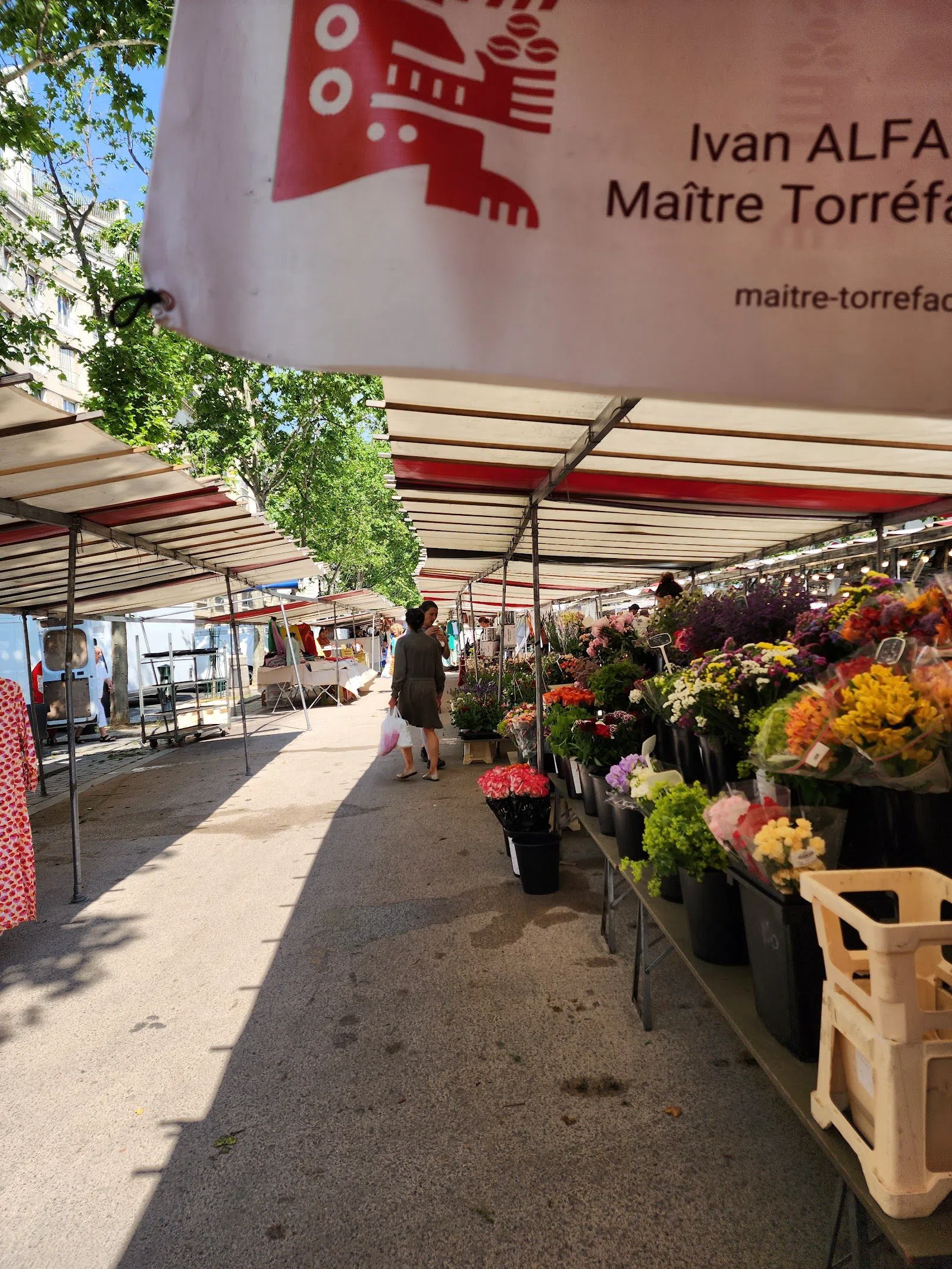
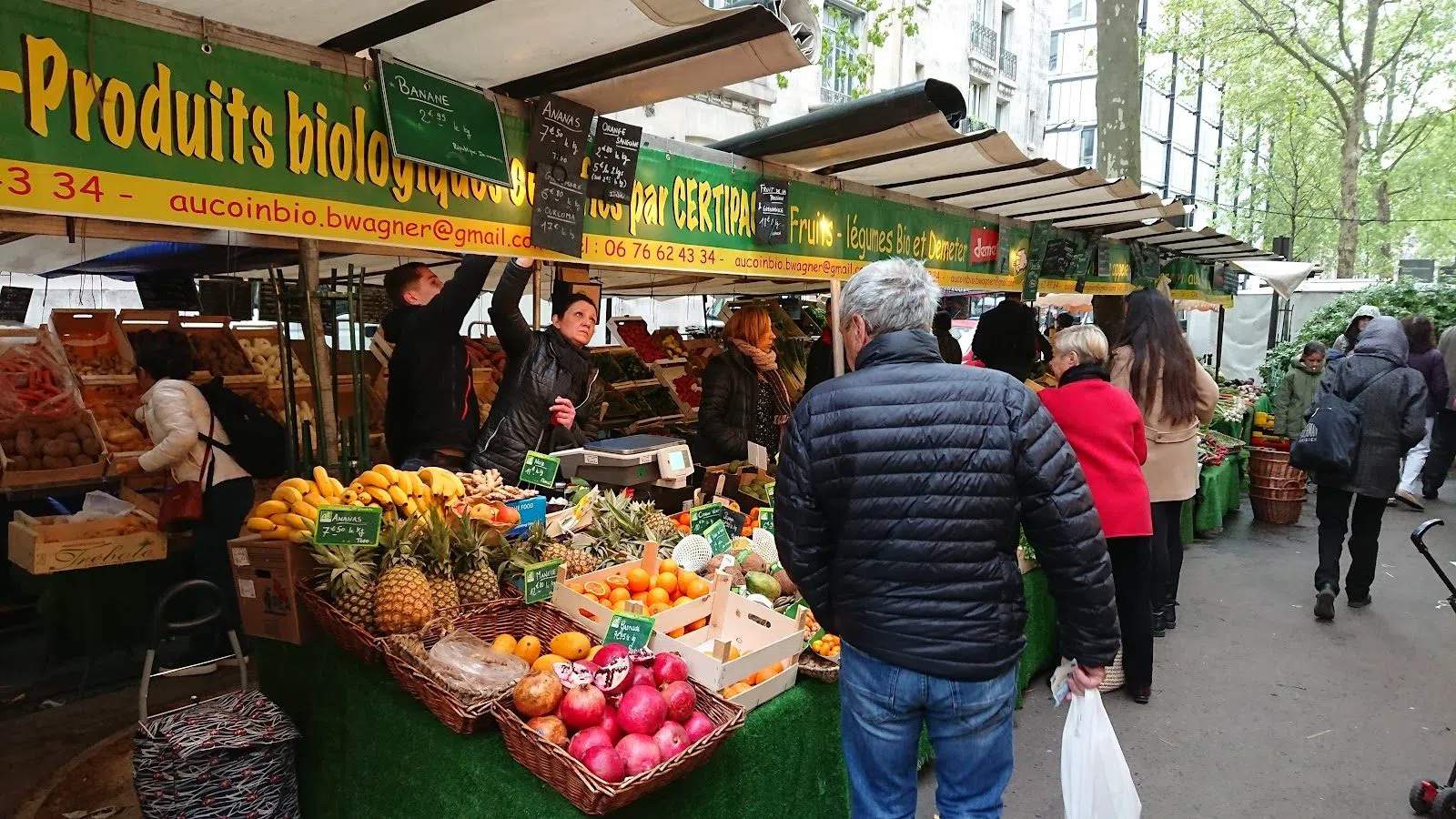
And on a Sunday, clear your morning for Marché Raspail — specifically the organic "biologique" market that takes over the tree-lined boulevard in Saint-Germain (6th) on Sundays only, 7am to 2:30pm (a smaller conventional market runs Tuesday and Friday). It's the celebrated organic market, an Ina Garten favourite, and it earns the reputation: dense, fragrant, generous with tasting. Prices carry the organic premium, but a hot buckwheat galette folded around cheese and egg costs only a few euros and is the correct breakfast to eat standing in the aisle. Come between 9 and 10am, before the lunchtime crowd swamps the lanes and the good stalls thin out. There's room for groups and tour stops, but the earlier you come the more the vendors have time to talk to you.
Market streets: shopping on the hoof
Where the markets keep hours, the market streets keep shops — permanent specialists lining a single lane, open most of the week, ideal when you want to graze rather than plan around a stall-up time.
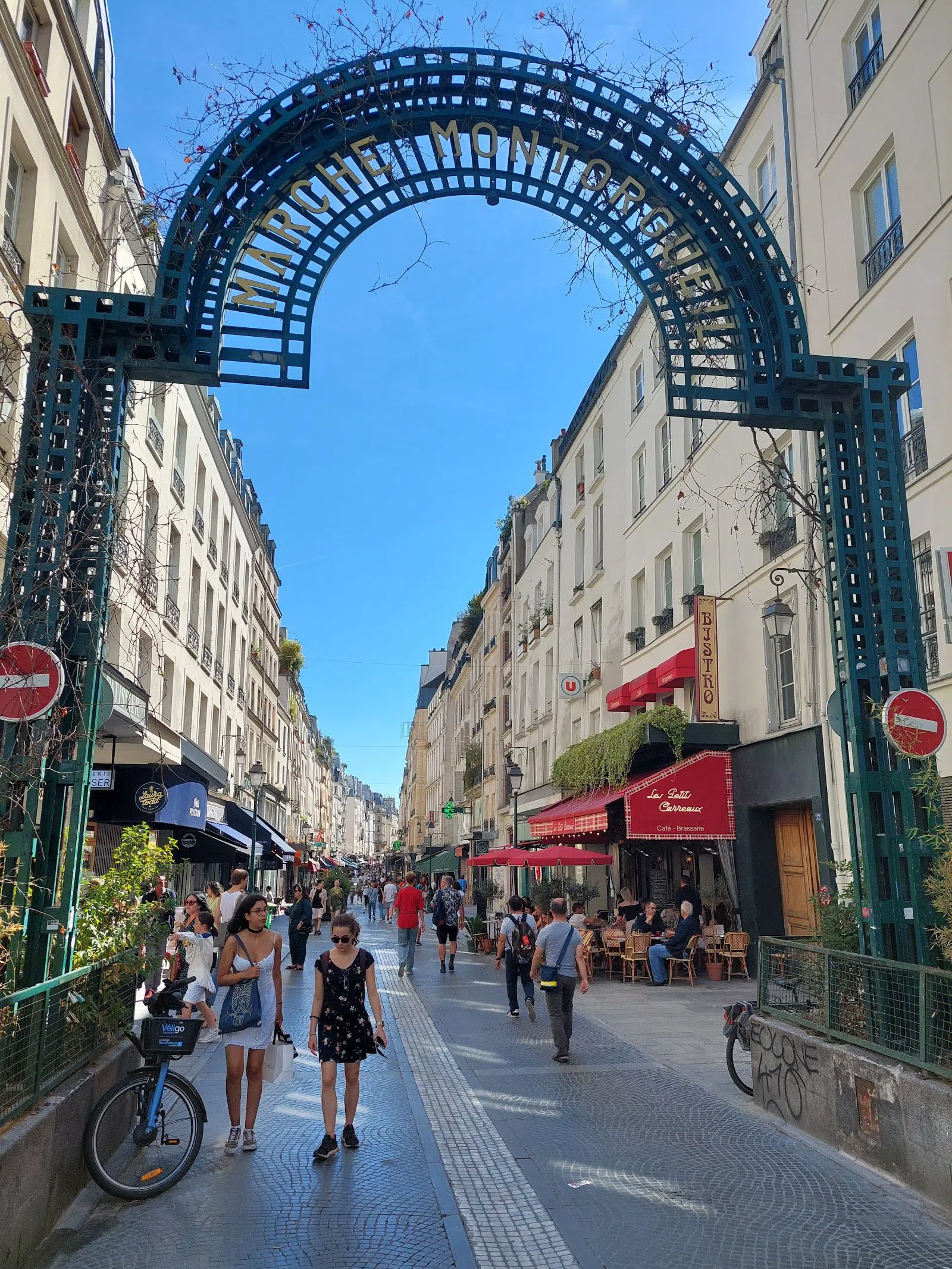
The most group-friendly of these is Rue Montorgueil (2nd), a wide, car-free street thick with terrace seating, cafes, cheesemongers, bakeries and oyster stands. Because it's pedestrianised and lined with places to sit, it handles groups and self-guided grazing far better than its narrower rivals — you can shop your way up one side, then actually sit down with a coffee or a plateau instead of eating on your feet. Shops open more or less daily and it's liveliest Tuesday to Sunday. Prices span € to €€. If your party can't agree on a plan, this is the safe, buzzy default.
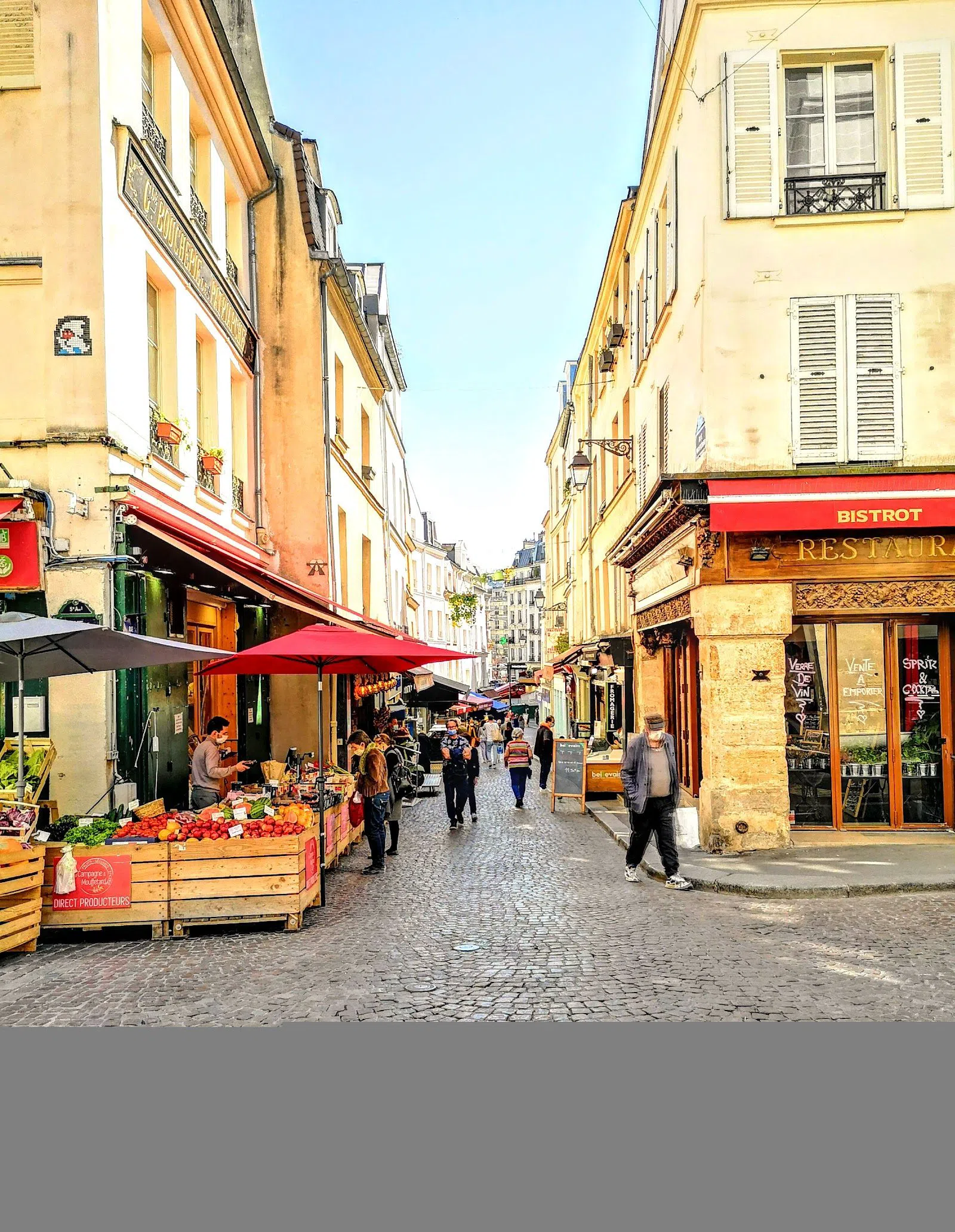
Its more famous cousin is Rue Mouffetard in the Latin Quarter (5th), the quintessential Paris market street and the backbone of most local food tours, open Tuesday to Sunday. It's gorgeous — a sloping cobbled run of tiny specialist shops, cheese caves and fromageries — but it's narrow, and that changes the group math. A small guided group of two to four moves through it beautifully; a large group clots the street and annoys everyone, vendors included. Come mid-morning when every shop is properly open and the light is good on the old signage, and keep your numbers modest.
Built for a crowd: the food halls and passages
Finally, the modern venues — engineered, weatherproof, and mostly designed for exactly the big-group nights the traditional markets can't handle.
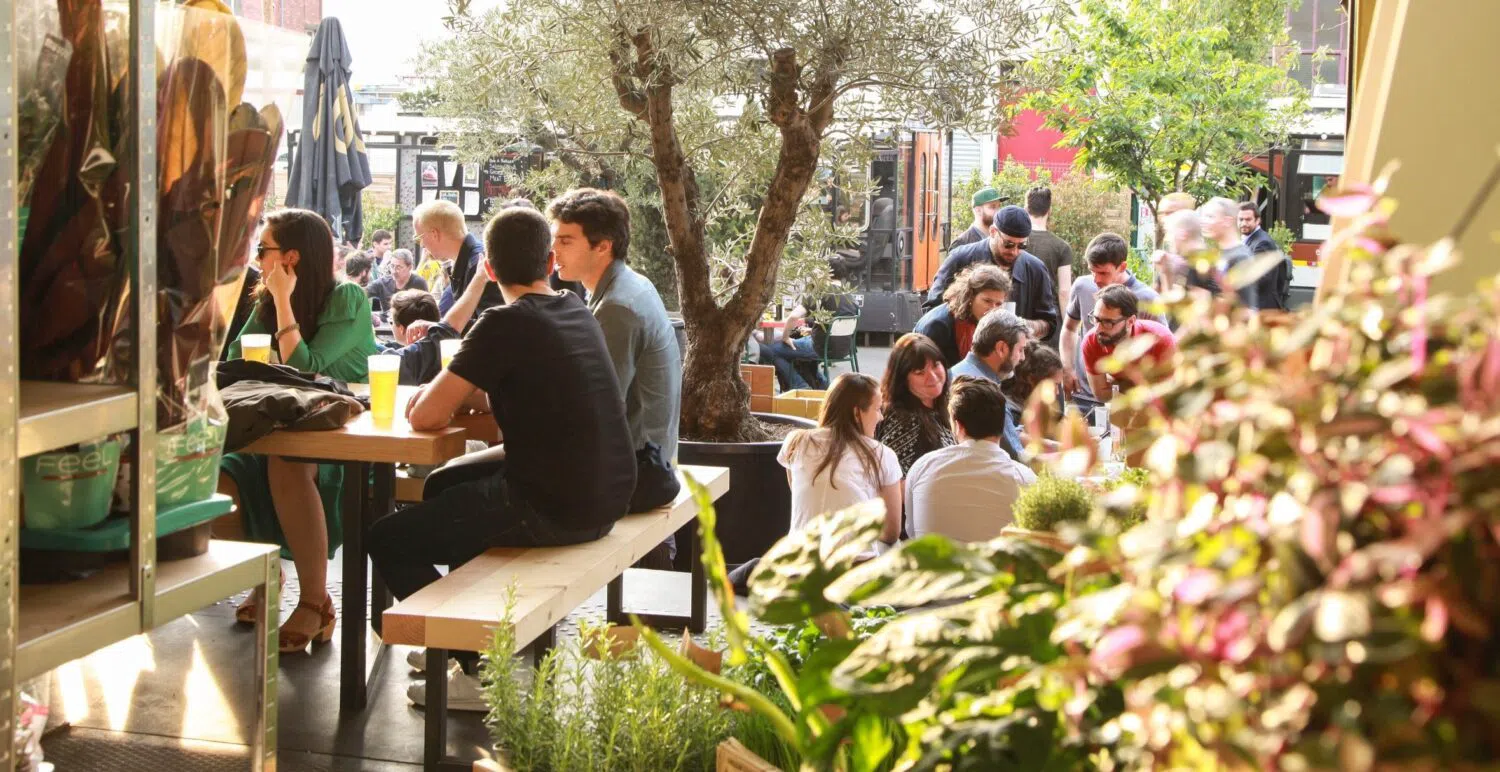
The most group-friendly room in the city is Ground Control near Gare de Lyon (12th), a vast reclaimed industrial space built explicitly for crowds and events. It's walk-in with acres of shared seating, it blends street-food kitchens, bars and cultural programming under one roof, and it can host private group bookings if you're organising something bigger. Mains run €12–18, cocktails €10–13, and it comes alive in the evenings and at weekends. If you're twelve people who can't agree on a cuisine, this solves it.
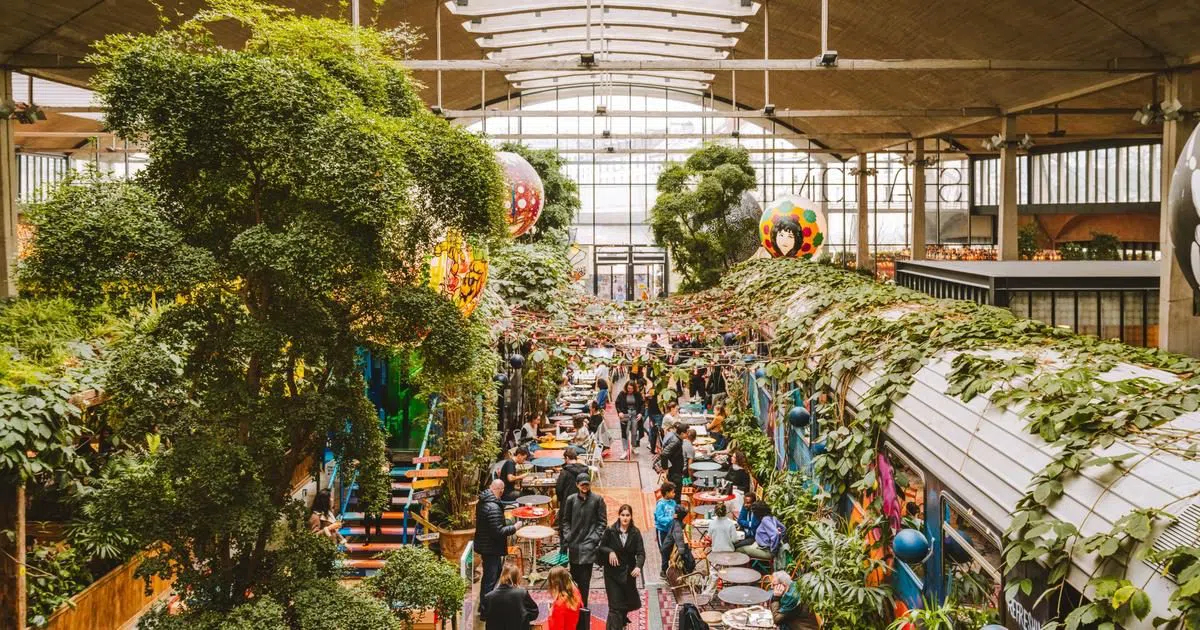
In the same spirit but louder and more theatrical is La Félicità at Station F (13th), the Europe-scale Italian street-food hall from the Big Mamma group and one of the largest single dining spaces in the city. No reservations — you come, you hunt for a table, you dive in. Pizza and pasta run €12–18, it is genuinely fun for large groups, and it is genuinely loud and heaving at peak. If you want the same food with room to hear each other, go off-peak. If you want the party, go Friday night and lean in.
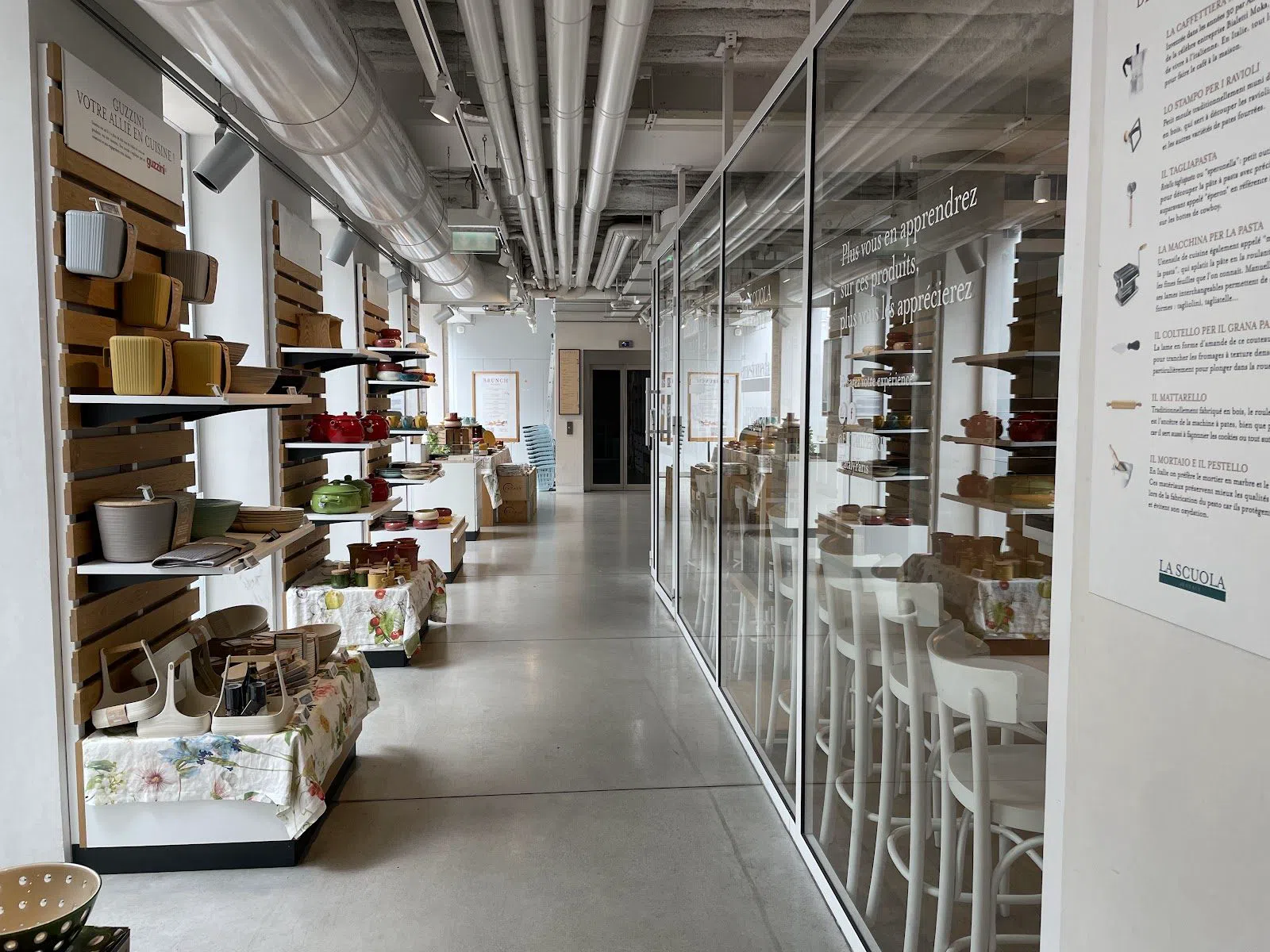
For a group that wants to shop and dine in one polished stop, Eataly Paris Marais (4th) is the all-weather answer: a spacious multi-floor Italian market and eatery in the heart of the Marais. You can walk in to browse the market freely, but for a group meal you'll want to reserve at one of the sit-down counters rather than gamble on tables. Restaurant mains run €16–26, and market prices vary with what you carry out. It suits mixed groups — the shoppers browse, the hungry ones eat, everyone regroups.
And for the refined end of the scale, Beaupassage on the Left Bank (7th) is less a market than a curated open-air passage of top-chef counters and terraces — a "best of French gastronomy" courtyard rather than a traditional market. It's relaxed for a couple or a small group grazing between counters; if you're a larger party, book a specific restaurant inside rather than expect to drift. Pricing is artisan-tier €€€. Come here for a slow, tasteful Left Bank afternoon, not a bargain.
Planning it well
Timing is everything. Open-air markets run mornings and specific days — Bastille on Thursday and Sunday, Président Wilson on Wednesday and Saturday, Saxe-Breteuil on Thursday and Saturday, Raspail's organic market on Sunday only, Aligre closed Mondays. Build your walk around whichever market is actually up that day, then fill the gaps with the covered halls, market streets and food halls, which open far more reliably across the week. For the covered halls and street markets, mid-morning is the sweet spot; for the big food halls, evenings and weekends are liveliest.
Cash and cards. Cards work almost everywhere in the sit-down halls and modern food courts, but on the open-air stalls plenty of vendors still prefer cash and a few are cash-only, so carry a little cash and a pocket of coins for the €2–€4 snacks. It also makes bartering at Aligre smoother.
Getting around. Everything here is on the Metro. Cluster your day by neighbourhood rather than crisscrossing the city: the Marais markets and halls sit close together, the northern-station covered market is a short hop from the terminals, and the Left Bank markets and Beaupassage form their own easy loop. Walk between anything within the same district — it's the best way to stumble on the shop you didn't plan for.
Budget, roughly. You can eat brilliantly for very little — a few euros of cheese, bread and fruit assembled across the open-air markets makes the best picnic in Paris. A cooked plate at the covered halls runs €8–16; a food-hall main with a drink lands around €15–25; the gourmet passages climb higher. Book a bed near the Marais or the Left Bank so you're walking distance from a market breakfast — start your Paris hotel search there.
Who suits what. Couples and pairs: the covered halls, Mouffetard, Beaupassage. Big groups: Ground Control, La Félicità, Bastille, Montorgueil. Everyone: Enfants Rouges, if you time it right and don't come mob-handed.
Eat the city the way it feeds itself — standing at a counter, coins in hand, on a first-name basis with the person doing the cooking. For the rest of your trip planning, our full Paris guide covers where to stay, what else to see, and how to string the neighbourhoods together.
Before you go
Which Paris food market is best for a first visit?
Marché des Enfants Rouges in the Marais is the definitive starter — the oldest covered market in the city, walk-in only, with international stalls where most cooked dishes run €8–16. Go before noon or mid-afternoon to dodge the lunch crush, and keep your group to two to five people since the shared tables fill fast.
What days are the open-air markets open in Paris?
They run on fixed days, so plan around them: Marché Bastille is Thursday and Sunday (about 7am–3pm), Marché Président Wilson is Wednesday and Saturday mornings, Marché Saxe-Breteuil is Thursday and Saturday mornings, and Marché Raspail's organic market is Sunday only (7am–2:30pm). Marché d'Aligre is closed Mondays. Covered halls and market streets like Montorgueil and Mouffetard open far more of the week.
Can you sit down and eat at these markets, or is it all takeaway?
It varies. The covered halls — Marché Saint-Quentin especially — have proper sit-down counters, and food halls like Ground Control, La Félicità and Eataly are built for settling in with a plate. The open-air street markets such as Aligre and Bastille have little to no seating, so they're best for grazing as you walk. Rue Montorgueil is the market street with the most terrace seating.
Which markets work for a large group?
For big groups head to Ground Control near Gare de Lyon and La Félicità at Station F — both are huge, walk-in and made for crowds — plus the wide boulevard of Marché Bastille and the pedestrianised Rue Montorgueil. Avoid taking a large party to narrow Rue Mouffetard or the packed tables of Enfants Rouges; split into smaller groups there instead.
Do Paris market stalls take cards or do I need cash?
The sit-down halls and modern food courts take cards almost everywhere, but many open-air stall vendors still prefer cash and a few are cash-only. Carry some cash and a pocket of coins for the €2–€4 snacks, and it also helps when bartering on the open-air stalls at Marché d'Aligre.