
The Paris Métro is the piece of the city's architecture that most visitors pass through a dozen times a day and never once look at. Above ground, wrought iron from 1900 still spells the network's name out in Hector Guimard's slouching capitals; below it, one platform has been riveted into a submarine, another carries the full text of the Declaration of the Rights of Man, and two more have sat dark since the week war broke out in September 1939. What follows is a route. Taken in order it costs the price of a few tickets, fills most of a day, and leaves you reading the ordinary stations differently for the rest of the trip.
Start at the one that never moved
Porte Dauphine (16th arrondissement, line 2) deserves the first stop because nothing about it has been moved or rebuilt. It is the only surviving original type-B édicule, the fully roofed kiosk rather than the bare railing, still standing where Guimard put it; it was restored in 1999 and is protected as a monument historique. Parisians nicknamed it La Libellule, the dragonfly, and under the fan of glass and green iron the reason is obvious. The canopy is carried as if on wings, and the whole thing reads as one continuous drawn line, not a set of parts bolted together.
It is free to look at, there is no door policy and no cap on numbers, and the pavement island it stands on is roomy enough to photograph a group of twenty without anybody blocking the stairs. That combination is rarer on this route than you would expect. If you are travelling with a party rather than as a couple, this is the stop where you brief them, hand out tickets and set the tone; almost every entrance further east is busier.
Guimard's ironwork along the Right Bank
Ride line 2 east and the ironwork keeps arriving. Monceau (8th arrondissement, boulevard de Courcelles) is the calmest of the great Guimard surrounds: a quiet residential boulevard, a single entrance, no crowd to work around. It was protected as a monument historique by decree in 2016, and the park gates directly opposite do the explaining for you. Two versions of the same Belle Époque city stand thirty metres apart, one civic and formal, the other all whiplash iron and organic curve. For a group of fifteen to twenty-five people this is the most comfortable stop on the list.
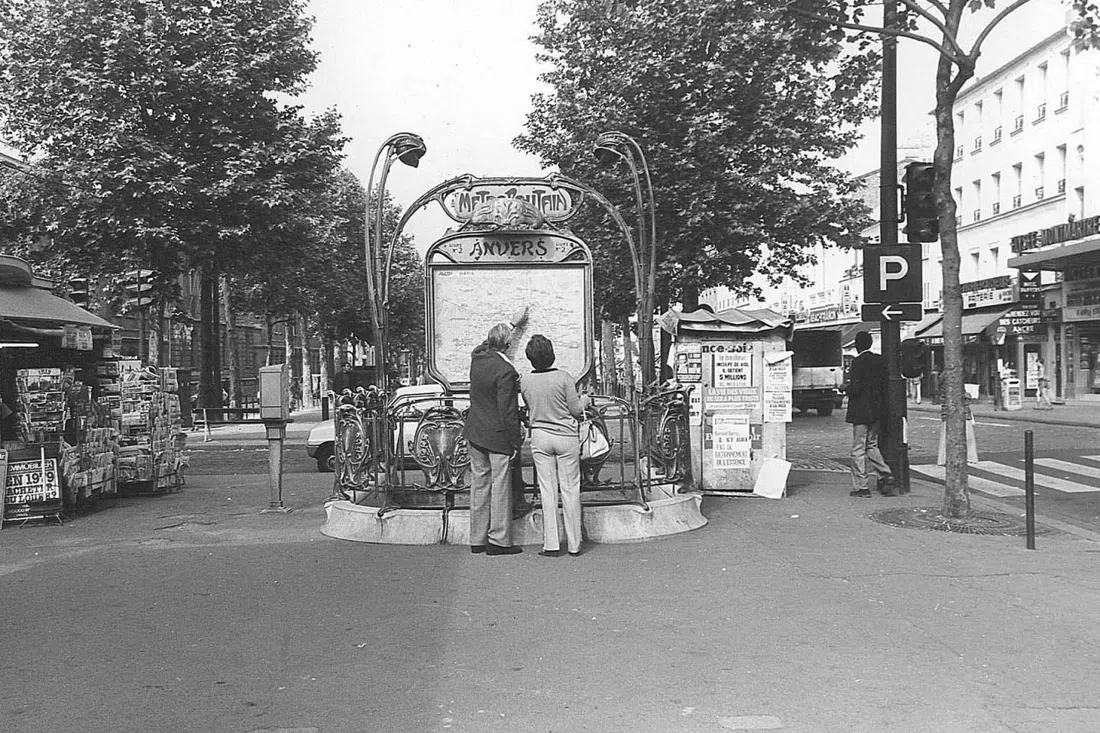
Anvers (9th arrondissement, square d'Anvers) is the opposite temperament. Inaugurated in 1902 and listed in 1978, it is the best-preserved Guimard surround in the north of the city, and also the main tourist door for Montmartre, standing about 100 metres from the Sacré-Cœur funicular. It absorbs groups, but it is genuinely busy from mid-morning. Come early if you want the ironwork uncluttered; come later and accept that you are photographing it through a moving crowd.
Abbesses (Montmartre, 18th arrondissement) is the other surviving glass-roofed kiosk, and its history is honest rather than pure: it originally stood at Hôtel de Ville and was moved here in 1974. Below it is the painted spiral stairwell, which is the reason most people come, and a genuine practical problem. At 36 metres this was the deepest station on the network until Villejuif–Gustave Roussy took the title in 2025. The single spiral staircase is a lovely descent for two people and a bottleneck for twelve; send larger parties down and back up by lift, and let whoever actually wants the murals take the stairs.
The island and the Latin Quarter
Cross to line 4 and the tone shifts from street furniture to engineering. Cité (Île de la Cité, 1st arrondissement) has been listed since 1965 and pairs a classified Guimard surround above with one of the network's most theatrical spaces below: a caisson hall sunk into the riverbed rather than tunnelled, closer to a ship's hold than a station. It is the only station on the island, so its single entrance carries everybody. That is fine for a group, but the stair flights are narrow. Two lifts, installed in 1911, give an alternative descent and are worth using with anyone who does not want to queue on the steps. You surface between Notre-Dame and the flower market, which makes it the easiest stop to fold into a day you were already having.
One stop south, Saint-Michel (Latin Quarter, place Saint-Michel) is the shot that sells the whole route: the classic entourage with its lettered sign, the version most people picture when they think of the Paris Métro, set against one of the best-known squares in the city. The entrance is wide open and takes any group size. The square does not. It is crowded from late morning onwards, and by afternoon you are negotiating with three other people trying to take the same photograph. Early is better here for the same reason it is better at Anvers.
Two centenary answers to Guimard
The Métro's centenary in 2000 produced two very different responses, and they sit within a short walk of each other. Châtelet (1st arrondissement, place Sainte-Opportune) has an édicule that is not original and does not pretend to be: a 2000 reconstruction, copied from the lost Gare de Lyon kiosk. It is the easiest place in central Paris to stand close to the complete édicule form and understand how the roof, the surround and the sign were meant to work as one object. The catch is traffic. This is the street door to the network's biggest interchange and it is used hard all day. Brief people on the pavement, never on the steps.
Palais Royal – Musée du Louvre (1st arrondissement, rue de Rivoli) holds the modern answer. Jean-Michel Othoniel's Kiosque des Noctambules, also commissioned for the centenary, strings coloured glass beads on an aluminium frame: the same instinct as Guimard's, an entrance that announces itself, in a wholly different material. What makes the stop worth planning around is the comparison available within 200 metres. Two listed Guimard surrounds stand against the Louvre wall on rue de Rivoli, so you can look at 1900 and 2000 in the same five minutes. The kiosk itself is small; view it from the pavement and take a group down through the rue de Rivoli entrances rather than crowding it.
Where the platform is the artwork
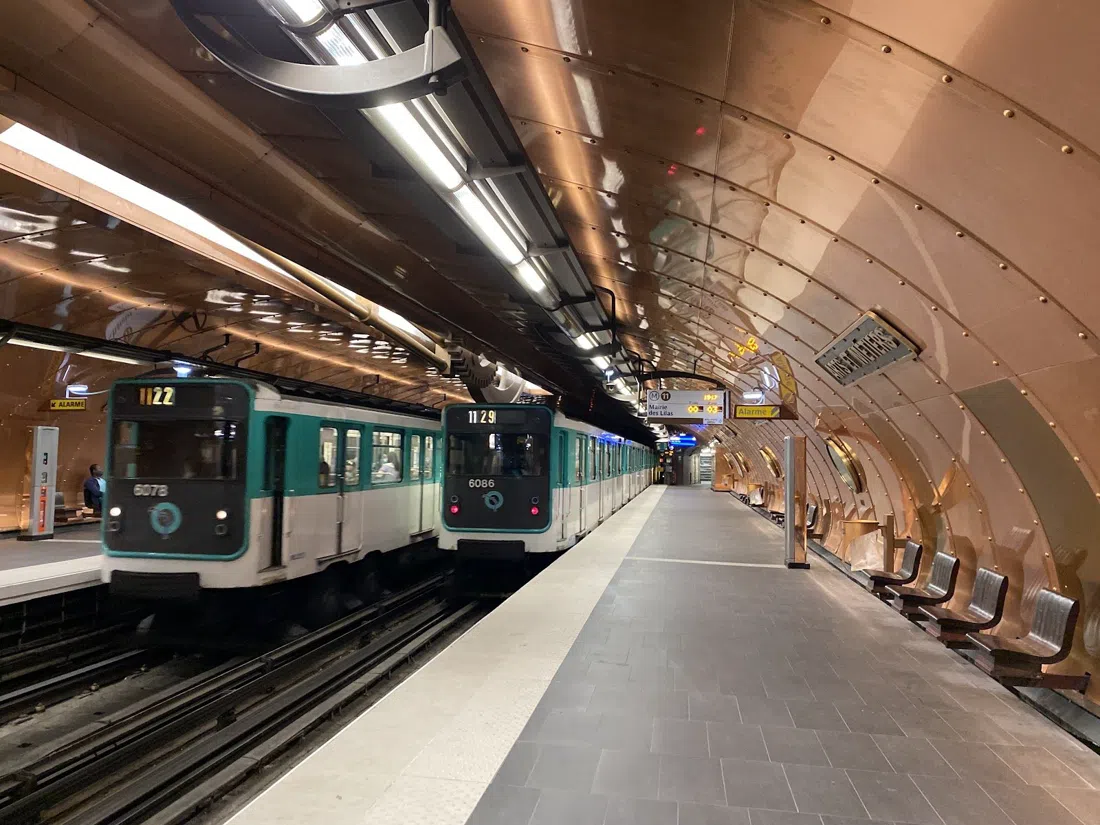
Three platforms on the network abandon neutrality entirely. Arts et Métiers (3rd arrondissement, line 11) is the famous one. François Schuiten's 1994 design for the Conservatoire's bicentenary lines the whole tube in riveted copper plate with portholes set into the walls, so the platform becomes the interior of Jules Verne's Nautilus. It is in service, free to anyone with a valid ticket or Navigo pass, and there is no barrier to groups. It is also a single narrow tube with no space to stand back, so go off-peak, keep behind the yellow line, and expect to wait a train or two for a clear frame.
Concorde (8th arrondissement, line 12) is quieter and stranger. Françoise Schein's 1990 work sets the complete 1789 Declaration of the Rights of Man and of the Citizen across roughly 1,000 square metres of white tiling, letter by letter, with no punctuation or spacing to help you; reading it is deliberate work. Be sure you are on the line 12 platform. The line 1 and 8 platforms below are plain, and people do come up disappointed having never found the right level. Line 12 is also the calmest of the three here, which makes it a better place to stop and actually read.
Louvre–Rivoli (1st arrondissement, line 1) was France's first museum station, created under André Malraux in 1968, and it comes with a caveat worth knowing before you make the trip. The nine large plaster casts (the Venus de Milo, the Seated Scribe and others) went to the Grand Palais–RMN workshops for restoration in spring 2026, and RATP has not announced a return date. The glass-case pieces are still in place, so the station is not empty, but you will not see the full display. Line 1 is automated and very frequent; keep people well back from the edge.
Bastille keeps what it lost
Bastille (11th arrondissement, lines 1, 5 and 8) belongs on this route precisely because of a loss. The original Guimard pavilion here was demolished in 1962; the surviving surround was shifted to boulevard Beaumarchais, where it still stands, orphaned from the station it was drawn for. That demolition is half the story of why so few édicules survive. For decades the ironwork was read as clutter rather than heritage.
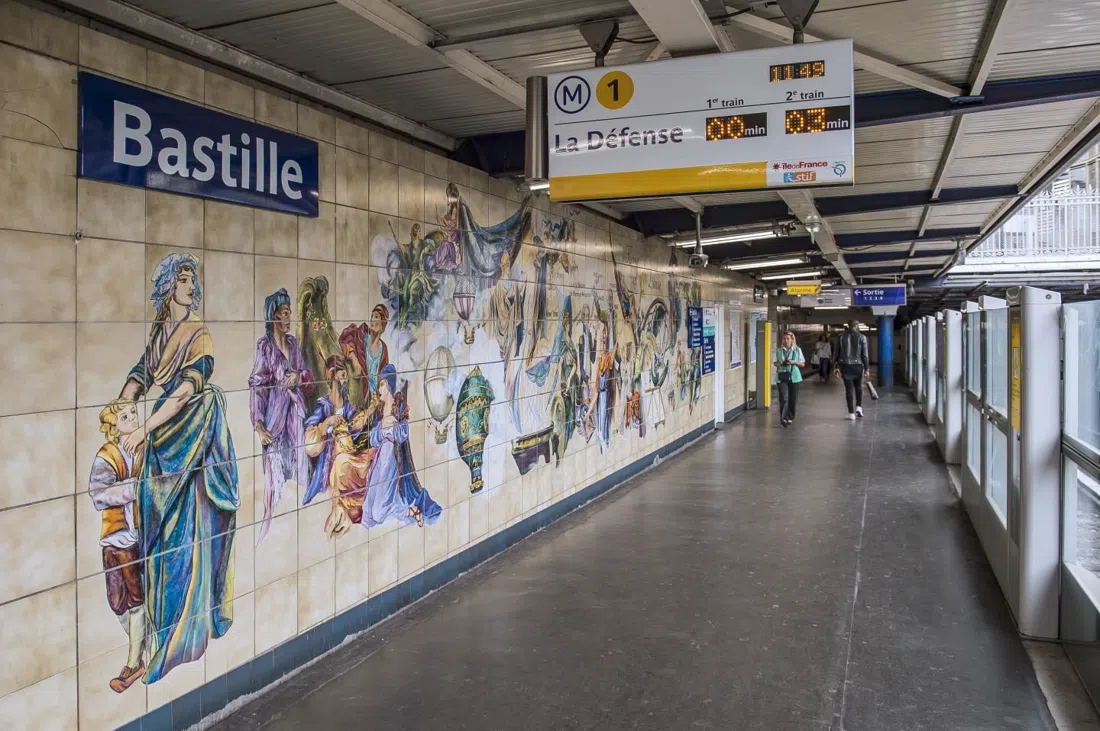
What compensates is underneath. Stonework from the fortress itself survives at platform level, so this is the one stop where the architecture and the history of the site collide without any interpretation panel needed. The platforms are large and multiple street entrances mean groups are absorbed easily, but the line 1 platform curves and has platform-edge doors; keep everyone back from the edge while they look for the stones.
Three stations that stopped
September 1939 closed a great many Métro stations and reopened most of them. Three are the reason this route exists at all.
Cluny–La Sorbonne (Latin Quarter, line 10) shut on 2 September 1939 and stayed dark for 49 years. It reopened in December 1988 with Jean Bazaine's mosaic Les Oiseaux spread overhead, and it is the hinge of the whole trip: the one forgotten station you can stand in rather than glimpse. The single entrance on boulevard Saint-Germain is busy, but the platform is wide and takes a group without difficulty.
Saint-Martin (10th arrondissement, viewed from line 9) never came back. It is the largest ghost station in Paris, and since the line 8 platforms were walled off in 2008 the only way to see it is from a moving train: take a westbound line 9 carriage between Strasbourg–Saint-Denis and République and stand at a window. Any group size works, because you are not stopping anywhere. Croix-Rouge (6th arrondissement, viewed from line 10) is the same discipline with less time: line 10's original 1923 terminus, closed in 1939 and never returned to service, still used for film shoots and photo campaigns. Sit on the right-hand side heading east from Sèvres-Babylone and watch for a two-second window of lit tiling.
The one you have to book
Porte des Lilas – Cinéma (19th/20th arrondissement border, lines 3bis and 11) is the station that only exists for the public a few days a year. Closed year-round, it is used around five times annually for shoots, among them Amélie and Ronin, and opens to visitors only for the Journées européennes du patrimoine, the European Heritage Days. Entry is free but ticketed online in timed slots, and the slots go within minutes. For 2026 RATP releases its free ticketing in two waves, at midday on 8 September and midday on 15 September; large group bookings are not offered, so everyone books individually. Set a reminder for those two dates.
Riding it in a day
A sensible order is Porte Dauphine → Monceau → Anvers → Abbesses for the ironwork, a coffee break in Montmartre, then Concorde and Palais Royal → Louvre–Rivoli → Châtelet through the centre, Cité and Saint-Michel on the island and the Left Bank, Cluny–La Sorbonne on line 10 with Croix-Rouge glimpsed on the way, and Arts et Métiers and Bastille to finish. Saint-Martin slots in whenever you are near line 9. That is a full day at a walking pace with stops, and it is easy to cut in half: the ironwork half and the underground-art half work independently. If you want the wider city context around these stops, the Paris guide covers what sits above each of them.
Practical notes
A single Métro ticket is €2.55 in 2026, or €17.35 for ten loaded onto a Navigo Easy card. The ten-ticket load is the obvious buy for this route, since you will make eight to twelve journeys. Everything on the list is free to view; you are only ever paying to travel. Any Navigo pass covers all of it, and the platform artworks cost nothing extra with a valid fare.
You do not need cash. Ticket machines and RATP counters take contactless cards, and there is no admission anywhere on this route.
Anvers and Saint-Michel are clear before about 10am and difficult afterwards. Arts et Métiers wants off-peak, so aim for mid-morning or early afternoon and avoid the 8am to 9am and 6pm to 7pm crush. Porte Dauphine and Monceau are calm at any hour. Porte des Lilas – Cinéma is heritage-weekend only, with booking opening at midday on 8 and 15 September 2026.
Monceau, Porte Dauphine and Bastille handle twenty-plus without friction. Abbesses does not, at least not on the spiral stairs, so use the lift. Arts et Métiers and the Palais Royal kiosk are physically tight and better in small numbers or in shifts. Nothing on this route has a door policy, but several of these places genuinely run out of room.
Allow €17.35 for the tickets and whatever you spend on coffee; the architecture itself is free. Staying central, in the 1st, 4th, 5th or 9th, puts most of this route within a fifteen-minute ride, and a Paris hotel search filtered to those arrondissements will save you an hour of travel across two days.